Southern Tier Fly Fisher

One angler's journey, fly fishing through life

Pompano on the fly…

Hey, are you Jeff Lowery? You sure look like him. He’s a fly-fishing legend around here. 

Shout-out from an old beach bum in Destin, Florida

He looked like Jim Harrison, the famous writer and fly fisherman, squinty-eyed, wrinkled, and tan as old leather. It was the second time in two days he had asked me if I was Jeff Lowery.

“You asked me that yesterday”, I said with a grin. “Oh, well you sure look like him”, the old beach bum replied. “He’s a fly-fishing legend around here. He fishes from a step ladder on the first bar”. And with that he promptly moved on down the beach in his quest for the elusive fly-fishing legend.

I had arrived early with the morning sun painting the beach and dunes sugar-white and the calm surf in hues of emerald and azure. The first and second bars were clearly visible with the deep blue of the troughs beyond them. The first bar was out 25 to 50 feet. That is where I needed to wade to intercept fish that cruised the trough and crashed bait against the shallows of the bar. It was late-April and the fishing report was that the pompano run was a strong one.

permit pompano spearfishing today
A tale of two cousins…

Pompano are a smaller cousin to the permit – the saltwater fish of fly-fishing dreams and one of the three gamefish of the tropical saltwater fly-fishing “grand slam”, the other two being the bonefish and tarpon.

Pompano can range up to 8 lbs., but fish over 5 lbs., are rare. Even so, they are built for speed with their forked tail and tall compact body. Their saltwater habitat is typically inshore and nearshore warm waters (70-89 °F), especially along sandy beaches, oyster bars and over seagrass beds. Because of their temperature preferences, pompano migrate northward in the summer, and then southward in the fall. Their range extends from Massachusetts to Brazil, but they are most common to areas near Florida. Like permit, pompano feed on crustaceans: sand fleas, small crabs, and shrimp. But they also eat mollusks and small baitfish. They are a member of the jack family (Trachinotus Carolinus) and like most jacks, are very fast swimmers and live in schools. They are bottom feeders with very short teeth made for crushing and their mouths are rubbery, much like a carp.

permit-zoom
The Permit – picture courtesy of Gray’s Taxidermy

I was not sure how to fish the pompano run so I started with a small Clouser in blue and chartreuse. The 9-weight cast it well on an intermediate line and a 6-foot leader tapered down to 15 lb., test. There was little wind to knock the fly down and almost immediately I felt solid taps on the retrieve. As I lifted the fly to re-cast, several small fish came screaming by the fly. I’d deal with these feisty fish all day, dime-bright bullets with tails in egg yolk yellow.

After a few more casts to the deep blue edge of the trough I felt a soft grab, somewhat tentative, followed by a few head shakes and then the jolting of the line and bright flashes in the water. The fish suddenly “grew” in size and made off on a run that pulled my rod down to the horizon, bucking wildly, and had me doing everything I could to keep the slack line feeding cleanly through the rod guides. In no time I had the fish on the reel, the drag screaming as the fish tore off to deeper water.

At times I gained on the fish, then it would reverse and peel out. This continued for 5 minutes and then wondering and hoping it was a pompano, my first pompano, I saw its gleaming deep side and the forked tail. I waded back off the bar into a small trough and up the beach. The fish slowly tired but still fought in the surf. I walked up the beach some more and dragged the fish out onto the beach.

It was a pompano – speed demon of the gulf surf! Its body shone bright in the sun – hues of silver and light blue, its back dark gray with hints of yellow on its underside and tail. The fish had inhaled the small Clouser so I clipped the line as close as I could and released it, feeling good about catching my first pompano.

OLYMPUS DIGITAL CAMERA
My first pompano on what would turn out to be one of those days to remember…

I waded back out to the first bar. The water was still relatively cool but the sun warmed me. The day brightened and the sea around me turned on with color. I now tied on a fly that imitates a sand flea, one of the principal foods of the beach-running pompano. Like permit, the pompano has a downcast mouth made for eating the bottom dwelling sand flea, among other crustaceans.

Vlahos sandflea
This sand flea pattern was just the ticket for the pompano that ran the troughs the day I fished. This fly was designed by Nick Vlahos and sold on his website (www.sandbarflies.com). The pattern I fished was sold at the Sandestin Orvis store and is called Vlahos’ Marbled Sand Flea.

I fished this fly deeply with short twitches and it wasn’t long before I was fast to another pompano. These fish are truly built for speed in the shallower waters of the surf, and it was evident why when I watched large porpoises in the outer bar that were feeding on them.

OLYMPUS DIGITAL CAMERA
Dolphins were not the only predator of pompanos on the day I fished. This fish fought hard for being so critically wounded by what was probably a small shark.

As the sun rose higher in the sky, I could see the pompano in schools cruising up and down the beach. I was able to sight-fish them, casting ahead or just short of the school. Though pompano are known for their Jekyll and Hyde feeding personality, on this day the “pomps” were turned on and lit up. Most casts I made were followed and the fly would be attacked even when it meant an about-face for the fish. While the sand flea fly was very effective, switching to Clousers and other bright saltwater streamers didn’t seem to make much difference.

OLYMPUS DIGITAL CAMERA
This fish displayed some yellow on its fins and a somewhat darker gray/blue back.

The fishing continued red-hot most of the morning into the early afternoon with 30 fish landed and quite a few more lost. Quite possibly the ultra clear water conditions and bright sun eventually ended the active bite. Pompano are known to prefer turbid waters so maybe too much sun was a bad thing.

OLYMPUS DIGITAL CAMERA
The beautiful Emerald Coast of Florida…

After 5 hours of epic fishing in the sun-drenched clear waters of the Gulf, I decided to give the rest of the day back to the fish. I had that good tired feeling as I walked the two miles to the beach access with the sound of a screaming reel and the sight of a deeply bent fly rod accompanying me the whole way. The pompano definitely put a smile on my face and a skip in my step and I was thankful to have met such a beautiful gamefish. I will be sure to return next spring, hoping the timing is in tune with the spring migration and maybe too, in time to meet my apparent fly fishing clone, the legendary Jeff Lowery.

Younger Next Year

The afternoon knows what the morning never suspected.

Robert Frost

We all go through at least a few life-changing moments during our winks on this good earth. For me there have been a dozen or so, most of them deeply philosophical, a few from the school of hard knocks, but two, detailed herewith, that are related to physical fitness. I can see the eyes rolling already; “yeah, yeah, yeah, another message about how important exercise is for good health and what the heck does that have to do with fly fishing anyhow”. Well, bear with me…

Step back in time some 36 years: the location is Camp Pendleton – a United States Marine Corps base in very arid southern California that stretches over 125,000 acres of coastal land made up of salt marsh, floodplain, oak woodlands, coastal dunes and bluffs, coastal sage scrub, and chaparral – basically a very inviting environment for long leisurely walks…

A leisurely walk, Marine Corps style…

While the weather was quite bright and warm, the greeting committee we NROTC midshipmen met was, well, less than sunny. And the accommodations – Quonset huts right out of Gomer Pyle, USMC, complete with a resident mascot bulldog that had the undershot jaw only an orthodontist could love and the attitude toward us newbies of a junkyard dog.  What stands out as most memorable about Camp Pendleton were the leaders we served with for that week – a Latino gunny sergeant whose name escapes me now but who talked about chevies (with a hard “ch”) and cleaning the rifle chamber (with a soft “ch”) – and a most charismatic “bully pulpit” major by the last name of Hatch who unabashedly took us “young guns” to task for being pathetically out of shape and then proceeded to lead us on runs through the hilly terrain complete with oh-so-colorful jodies. I recall one “speaking to” after a run through the hills when we were severely dressed down for not being able to keep up with a man twice our age. So taken was I by the esprit de corps of the place that I remember leaving Pendleton wanting to become a marine officer. A childhood asthma diagnosis ultimately prevented me from walking down that path. While that might not have set well with the mighty major, I think he would be pleased that I have tried to remain fit all the years since…

Fast forward to the summer of 2008: I’m fishing the Chenango River, late one summer afternoon. I round a bend in the river and see another fly fisherman – hunched a little, butt-deep in the river – he false-casts his fly two or three times with nice loops in an easy, almost effortless motion. It’s a rare sight: he is only the second fly fisherman I’d seen on the river in the course of 10 years. I slowly fish my way down to him.

I wade with the river, working my streamer down and across, then pull out just upstream of him.  He has a gentle manner about him, and is so soft spoken that I have to draw close and listen cup-eared just to understand his words above the river’s soft murmur.  He’s an older man, early to mid 70’s. His face is drawn, his eyes worried…

We talk fly fishing for a bit; he prefers fishing dry flies but laments the days of chasing trout in the faster rivers of the Catskills are largely over. As he says this, he glances down at the long wooden wading staff attached to his waist and wagging atop the water below him.

I wish him luck and wade downriver as evening sets in. A few times I turn upriver and observe him in the same spot, but eventually, imperceptibly, he removes himself from the river. As I finish fishing and hike back to the car, I double back on my promise to keep physically fit but this time the promise is targeted on fighting off aging so that I may actively fish well into my eighties, and even beyond, God-willing.

Sometime after my riverside re-awakening, I came across a book that would be that second life-changing moment related to physical fitness. The book was titled, “Younger Next Year” co-authored by Chris Crowley, a 70-something ball of energy, and Henry “Harry” Lodge, M.D., his internal medicine doctor. The two trade chapters: Chris providing the application and real-world experience side of the book and Harry, the medical facts and reason behind the advice. The book’s premise: if you can fight the biological clock by sticking to some basic rules, you’ll live like you’re 50 well into your 80’s and beyond. I read the book and was compelled to read it again with highlighter in hand.

41Pxex2rEhL._BO1,204,203,200_

Harry’s Rules are so simple that one might question buying such a book. But it’s what’s behind the rules that fascinated me most. The medical detail behind each rule convinced me of the book’s worth and reminded me of a common criticism I have of the medical profession: that many doctors preach rules, order tests, but rarely take the time to explain “why”…

So, here are Harry’s Rules:

1. Exercise six days a week for the rest of your life.
2. Do serious aerobic exercise four days a week for the rest of your life
3. Do serious strength training, with weights, two days a week for the rest of your life.
4. Spend less than you make.
5. Quit eating crap.
6. Care.
7. Connect and commit.

Notice that the rules go beyond being just a gym rat, another thing I loved about the book. And even the importance of non-physical rules, such as “Connect and Commit” are backed by sound medical rationale.

The book is a delightful read, especially for us older guys. It’s written by a guy who can relate to age and by a doctor who sees daily, the results that lifestyle can have on one’s aging. Harry and Chris use the mantra, “grow or decay” throughout the book and it is a good one to remember as is their chart that depicts normal aging and what “old age” can be.

Here, according to the authors, is how we typically age…

slipperySlopeAging

And here is the aging process if we live by Harry’s Rules…

th (1)

According to Harry, over 70% of premature death and aging is lifestyle related and that through simple lifestyle changes, captured in Harry’s Rules, over half of all disease in men and women over 50 could be eliminated.

The choice is ours. We can look at aging and all the associated aches and pains and limitations as normal, or we can choose to delay the onset of the slippery slope, and continue to live well into our 80’s.

And so I’ll begin 2016 with another read of Younger Next Year. I’ll think of all the fishing left to do in my life and remember the old guy on the Chenango. I’ll re-commit to fighting the relentless tide of old age, with Harry’s Rules in hand, so that I can still venture out and wet a line well into my 80’s. And with a little luck, maybe I’ll hear the young bucks over the roar of the fast water say, “would you look at that old guy?”

A Memorial to Maddie…

AKC Miss Maddie of Darlington – “Maddie”

September 2013 – November 2, 2024

I am here tonight, in a still house. Putting a dog down is never easy – coming home to the quiet of a dog’s absence, is even harder. I walk in and there is no longer a greeting. Our Maddie had a bit of separation anxiety and was often found just inside the door waiting any time her people left her. I am eating pizza – comfort food for an uncomfortable day – and as I work toward the crust, I am reminded how much she loved a piece of crust. Her toys lay about – her brush is still full of her hair. Her water and food bowls are not empty – she had no hunger amidst the pain of the osteoarthritis that ravaged her body on that last day. I turn to shut off the outside lights and am reminded that I would normally walk her beforehand.

Other triggers await as if in ambush – dogs being walked with wagging tails, a young grandson wondering where she went, neighbors asking afterwards, and the vet bill, her remains in a box, and paw prints.

A dog cannot communicate like us humans, but I think she knew. Osteoarthritis plagued her in later years – she could not sit up straight on her hind legs; with time she needed help just getting up to a couch or bed.

But life goes on and you take these things in stride, still wondering whether she should have been appreciated all the more.

Maddie on her “gotcha” day, at 5 months old.

In her last 2 years of life, she was my constant companion as I transitioned from work to retirement to getting our Vestal house ready to sell and finally selling it. My wife was up at our house in Rochester – wherever I went Maddie would go.

Now it is a quiet time. My wife is in bed after the long emotional day. It is just me and the fire on this cold November evening and a glance toward her corner reminds me. Dogs are, as my son reminded me on our drive home on that final day, one of the great human experiments. That experiment began with a wolf that hung at a distance in the din of a fire, and gradually accepted scraps. And it still evolves with hundreds of distinct breeds, designed to help man in all ways, from detecting bombs to therapy for dying humans, to companionship.

In my mourning, I somehow stumbled on an account of a little boy, who witnessed his own dog being put down in the company of his family. The family was very attached to their dog, an Irish Wolfhound called Belker, but nobody was more attached to this dog than 6-year-old Shane, the little boy. The family had taken their dog to the vet, only to find that the 10-year-old dog had cancer and that nothing could be done for him. The vet offered to euthanize Belker in their home, and after much discussion, Shane’s parents agreed that it would be good for Shane to be there so that he might learn something from the experience, given how attached he was to Belker.

The time came yet Shane seemed very calm. He was stroking his dog in a way that suggested acceptance, and it was as if both him and the dog understood that this was goodbye. Belker slipped away peacefully within a matter of minutes. Shane didn’t cry nor did he show any signs of distress. He knew it needed to happen and he knew Belker was in a better place. Afterwards, the family asked, in discussion, ‘why are animal’s lives so much shorter than our own?’ Shane sat quietly before saying “I know why” and went on to explain that people are born so they can live a good life. They need to love everyone all the time and be nice. Dogs already know how to do that, so they don’t need to spend their entire lives learning how to do it. That’s why they don’t stay as long

I am writing this as my own therapy, for a dog who loved unconditionally and gave her life for my good and the good of our family. Stack the monumental progress of humans against that, and I assure you, there’s no comparison. We will miss you Maddie…

More on Maddie – no better friend…

The following blog post was originally published on 12/5/2014, as an update on our adoption of Maddie. Her official “gotcha” day was February 23, 2013. We believe she was born in September 2013.

Those who follow this blog know a little about Maddie. I posted a piece on our adoption of her, or perhaps I should say her adoption of my family. She was a “return”. Previous owners had adopted her as a young puppy, but we believe may have found her too much to handle. So, she was lovingly taken back by her foster shelter, Every Dog’s Dream, in Greene, NY, and after we saw her photo, it was, as they say, love at first sight…

Most people know that Labs love the water. But Hound / Lab mixes like Maddie – well, I wasn’t so sure. Maddie is a Treeing Walker Coonhound and Labrador Retriever cross. She has the ears of a Lab, the head of a coonhound, the coat of a Lab and the tail and deeper chest of a coonhound.

The Treeing Walker Coonhound…

She’ll bay like a coonhound, even stand up to a tree if she’s chased a squirrel, yet she also has a deep bark that warns with authority. She’s goofy, playful, wicked fast, retrieves, and loves her toys…

A dog's gotta have toys...
A dog’s gotta have toys…

Maddie first met water not long after we adopted her in February of 2013. And beautiful Jones Park in Vestal was the site of our first forays in field and stream. Maddie loved the snow and the woods, but ice and water took some getting used to. The first time I crossed the brook there, she paced back and forth on the other side, whining aloud before finally being coaxed across the frozen surface of the brook. From there on though, she started liking water, and these days that little brook is a favorite of hers.

Beautiful Jones Park - this little brook was Maddie's intro to the wonderful world of woods and water...
Beautiful Jones Park – Maddie’s intro to the wonderful world of woods and water…

But that was generally shallow wading with the exception of a few plunge pools. It took most of the following summer before the Susquehanna River dropped low enough for easy wading and the perfect opportunity to introduce Maddie to real swimming and maybe even some river fishing. My first trial would be a “no pressure” jaunt to an area above the Campville fishing access where there was a lot of water with a gradual transition and areas shielded from river current. We took a ride there one Sunday summer afternoon. While I had my fly rod, the goal was to wet wade and fish casually, inviting Maddie to join the water and “fish” with me.

It’s never an issue getting Maddie to take a ride in the car. Open any door and she’s eager to climb in and take up position in the back seat. She’ll then plant both front feet on the center console and look forward, or roam across the back bench seat, poking her head out either open window, ears flapping in the wind. It’s a sight to see in a little Subaru Outback and reminds me that one day I really do need to get a pick-up truck…

Cruising and scoping out the countryside, Maddie style...
Cruising and scoping out the countryside, Maddie style…

So after we arrived at the large DEC access, I took a few minutes to rig up, and then set off up-river, through the woods. Maddie was all over the place in her usual land rover style; sniffing, marking, chasing chipmunks and squirrels – all good doggie stuff. We walked out to a large rocky bar on the river and there we did a little wading as I cast my line. Maddie never strays afar – possibly an attachment issue from her past. She was right by me the whole time. I waded into the river until she almost moon-walked the bottom – and that was good enough for our first adventure. I didn’t want to push it.

Maddie wades the Susquehanna shallows...
An intro – Maddie wades the Susquehanna shallows…

The following week we repeated the same exercise. Maddie was a lot friskier, chasing plovers, wading in where I fished while watching the fly line where it entered the water. We waded deeper this time but I wasn’t having much luck with the bass. Eventually we headed to a feeder creek with a very deep hole. I spied a bass in the hole and cast my olive soft hackle bugger across the pool. It was like ringing a dinner bell as 4 bass quickly emerged from the green depths. These fish had most likely been trapped in this hole all summer – the feeder creek tailed out to a slight trickle before entering the river – and as the saying goes, beggars can’t be choosers in a spot like that. The biggest of the bass struck my fly aggressively, not wanting to let such a meal get by, and a good tussle began. The fish darted towards the security of a downfall and root ball. I put the brakes on while hollering for Maddie. I lipped the bass, removed the hook, gave Maddie a chance to say hello, and then released the bass. Maddie literally dove right into the hole in pursuit and soon experienced water without bottom. She came dog-paddling back, no worse for wear, and a certified swimmer!

Scoping out the faster water....
Surveying the faster water and making Dad a little nervous from afar…

I was thrilled, but never doubted she could do it. So we returned to the river the following week with a plan to explore a little more. I wondered, would she travel down to the honey hole – the one where the bass could be big – the one I loved to fish?

We got to the access and this time took a wooded path downriver. The path paralleled the river for a bit and then veered off along a river braid. As we hiked, Maddie would dash down to the river braid and then charge back up to find me, flying up 6 foot banks like they were nothing. Soon we came out where the river braid re-entered the river at a beautiful bay that I love to fish…

This is sweet water for fly fishing and fishing this spot gave Maddie the opportunity to explore the river-side and take a swim.

Loving the river...
Loving the river…

Soon after arriving, I cast and swung my olive soft hackle bugger through a chute of water from the river braid and that proved to be a little too much for one nice bass. The fish took the fly solidly and went airborne with the hook-set. Maddie rushed in deep where the bass zigged and zagged, trying to intercept it. At one point it darted between her legs!

A nice smallmouth landed with aid of a water dog - note the paw in the upper left...
A nice smallmouth landed with aid of a water dog – note the paw in the upper left…

Soon enough I had the bass lipped, then removed the fly and put it down for a picture – Maddie’s paw included. Maddie began pawing the bass as I put my camera away and that was enough to send it off in a big swag of its tail.

Soon after hook removal, an errant "pat on the back" sent this bass fleeing...
Soon after hook removal, an errant “pat on the back” sent this bass fleeing…

But as the saying goes, all good things must end. So it was for our river sojourns. Not long after enjoying these visits to the Susquehanna, the rains came, the river rose, and then the cold swept in. Summer faded to fall and then to “see you next year”. No matter, it was great to have a fishing buddy on the river with me…

Relaxing on the deck with a glass of wine after a good day on the river...
Relaxing on the deck with a glass of wine after a good day on the river…

And borrowing a prophecy picture from my original post on Maddie, I’d say she’s turned out to be quite a friend for a fly fisher…

Oh the places we'll go...
Oh the places we’ll go…

Say Hello to Maddie

The following blog post was originally published soon after my family adopted our wonderful dog, Maddie. Her official “gotcha” day was February 23, 2013. We believe she was born in September, 2013.


If there are no dogs in Heaven, then when I die I want to go where they went.

Will Rogers

Will Rogers said it best: dogs are good. They live their short lives on this earth looking up to whomever walks into their lives and this goes back to early man who was looking for a guardian, hunting companion, and beast of burden.

Dogs have come a long way, all in service to man...
Dogs have come a long way, all in service to man…

Dogs don’t judge; they are the very essence of unconditional love. Come home from after a bad day, depressed, tired, even angry, and though they’ve been home all alone, they come to you, tail wagging, as if Jesus Christ had just come back to earth.

Long are the tales of a dog’s absolute devotion and loyalty. Hidesamuro Ueno brought his dog, an Akita named Hachiko, to Tokyo in 1924 and every day when he left for his teaching job, Hachiko would stand by the door and watch him go. The Akita would then arrive at the local train station at 4 p.m. to meet his owner when he returned from work. Ueno later died of a stroke at work, but Hachiko continued to return to the train station every single day for the next 10 years until his death in 1935. A bronze statue stands at Shibuya Station in honor of Hachiko.

Hachiko: loyal to the end...
Hachiko: loyal to the end…

Then there’s Hawkeye, the Labrador retriever, that showed dogs too suffer from heartbreak. During Navy SEAL John Tumilson’s funeral, Hawkeye was seen ambling up to his owner’s coffin and then dropping to the ground with a heaving sigh.

Hawkeye, a chocolate lab, grieves for his fallen owner...
Hawkeye grieves for his fallen owner. No greater love…

Indeed, I remember my grandmother once saying she never trusted any person who didn’t like dogs…

Up until very recently, I’d been dog-less for too long. I grew up with dogs, after all, starting with Cocker Spaniels, thanks to my grandparents who bred and showed them. Blue Bay was their kennel – home to many champions of conformation and obedience. Years later my wife and I owned Basenjis, a unique hound breed out of Africa, known to many as the ‘barkless dog’. We showed Kephas (our male) and Yodie (our female), and after finishing them as AKC Champions, they had a litter of 5 puppies. The litter pick, Blue Bay’s Violet Memory, was named in honor of my grandmother and was my way of thanking her for bringing dogs into my life. ‘Violet’ produced many champions. One of her descendents was the first black and white Basenji to win the breed at Westminster.

Kephas and Yodie passed on, as all dogs do, and we took a break from dogs. It was nice at first not having to walk a dog in the pouring rain or frigid cold, shouting under one’s breath every expletive known to man in front of ‘just go…!’, and yes, the house seemed a lot cleaner, dirty laundry left undisturbed, cherry cheesecakes not yanked off tables, etc., etc., but after a few years without panting and yodeling and all those dog antics – comic and touching – well, something was missing. My wife stood fast for a while, claiming she wanted to enjoy the house ‘chew-free’, until out of the blue, she noticed this picture in the news…

Those eyes...
Those eyes…

The rest, as they say, is history. A week after noticing this Lab / Hound mix, we all went to see her. The bond was immediate and magical. It wasn’t another week before she was brought to us, courtesy of Every Dog’s Dream, a pet shelter in Greene, NY. Maddie wagged her way into our lives and where my wife saw a good walking companion, I immediately dreamed of a fly-fishing friend.

Maddy...
Maddy…

It turns out that Maddy was one of a litter of 4 puppies born somewhere in South Carolina. The litter had been left to a high-kill shelter, where dogs are put down if not adopted in 90 days. Fortunately, Maddie and her littermates were sent north. Audrey at Every Dog’s Dream referred to Maddie as an adorable, big-hearted girl who had good manners and liked being close to her humans. Our adoption proved she was more than right.

While pure-bred dogs have their place in life and certainly serve a purpose, the sheer number of homeless dogs continues to sky-rocket. Many of these dogs are real gems, such as we have found in Maddie, and all they’re looking for is a chance to warm a heart.

My plans for Maddie include lots of love and play, obedience training, and ultimately, a seat beside me on the way to flowing waters.

LetsGoFishing600px

I know the Lab part of her breeding will win her over to water and I’ll promise her this…

“Oh the places you’ll go! There is fun to be done! There are points to be scored. There are games to be won. And the magical things you can do with that ball will make you the winning-est winner of all.”
― Dr. Seuss, Oh, the Places You’ll Go!

Winter Storm

For everything there is a season, and a time for every purpose under heaven.

Ecclesiastes 3:1

My phone buzzed with an incoming text while I built a fire in my fireplace. It was my cousin’s husband, John.

“Did u get much snow?” John texted, in his characteristically straightforward prose.

I responded with a picture out our back french doors.

We parried back and forth a bit, John taunting me with the 50 degree weather he was having in North Carolina and his plans to fish. “Should have some luck with the bass.” he texted.

I replied simply with “bastard!” and added another log to the now growing fire. Then I poured a glass of Langevulin and settled down to the business of rod wrapping snake guides on an 8-weight fly rod I was building.

Outside my little study, the wind howled and the white stuff was flying nearly horizontal. The temperature had been falling by the hour since morning. Snow piled high on the ground and blew in tall drifts. And the more I thought about the winter weather, the more thankful I was for being trapped by it all.

These days it seems that almost no matter where one lives, there’s an open fishing season to be had. On the one hand, it is nice to be able to get out and shake off the rod rust. The abundance of flexible fishing also provides ample opportunity to fish for species that were once closed to a strict calendar date. Trout, back in the day, were off limits from October through March, the opener dependent on the state. Bass season was also closed through winter. But for me anyhow, the true depths of winter provide a fishing respite in a way – a time to step back, work on gear, re-stock flies, build fly rods, make plans, do maintenance and repair, inventory tackle, and set goals for the year ahead. It’s time to do work the work of Stephen Covey’s 7th Habit – “Sharpen the Saw”.

Covey’s 7th Habit is all about the critical importance of self-renewal. The analogy is the saw – one can use a saw until it dulls. Further sawing just increases the workload and the wear until the sawyer is exhausted, the work utterly inefficient and now ineffective. By my way of thinking, time off from fly fishing is a necessary thing, just as rest is important to effectiveness during our hours awake.

Beyond that, there’s something to be said about absence making the heart grow fonder. When I was a boy, I would look forward to Opening Day through what seemed like an endless winter. The anticipation of that magical day just sweetened the experience all the more. It made one savor every aspect of it – waking early to the smell of hot coffee, and eggs and bacon – the chill of the air, the crunch of the remaining snowpack, the taste of the lunch packed, the anticipation as I drifted a worm through the dark waters of a pool, and the tug, that blissful tug of a trout.

As is said, to everything there is a season. Perhaps we should get back to spending more time on sharpening our fly-fishing saw and storing up that wonder and anticipation of another day astream…

The Cobbler

“Remember, cobbler, to keep to your leather.”

Michel de Montaigne, French philosopher, on staying true to one’s craft.


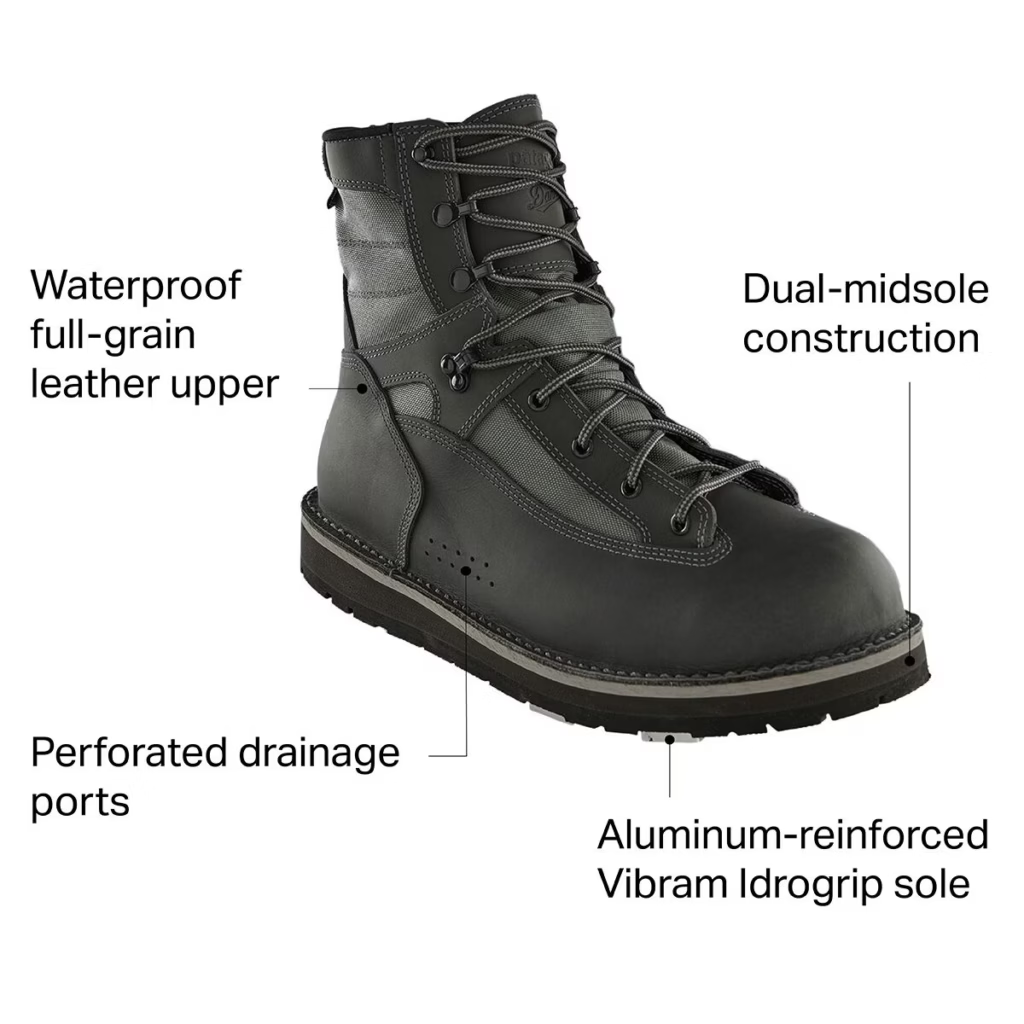
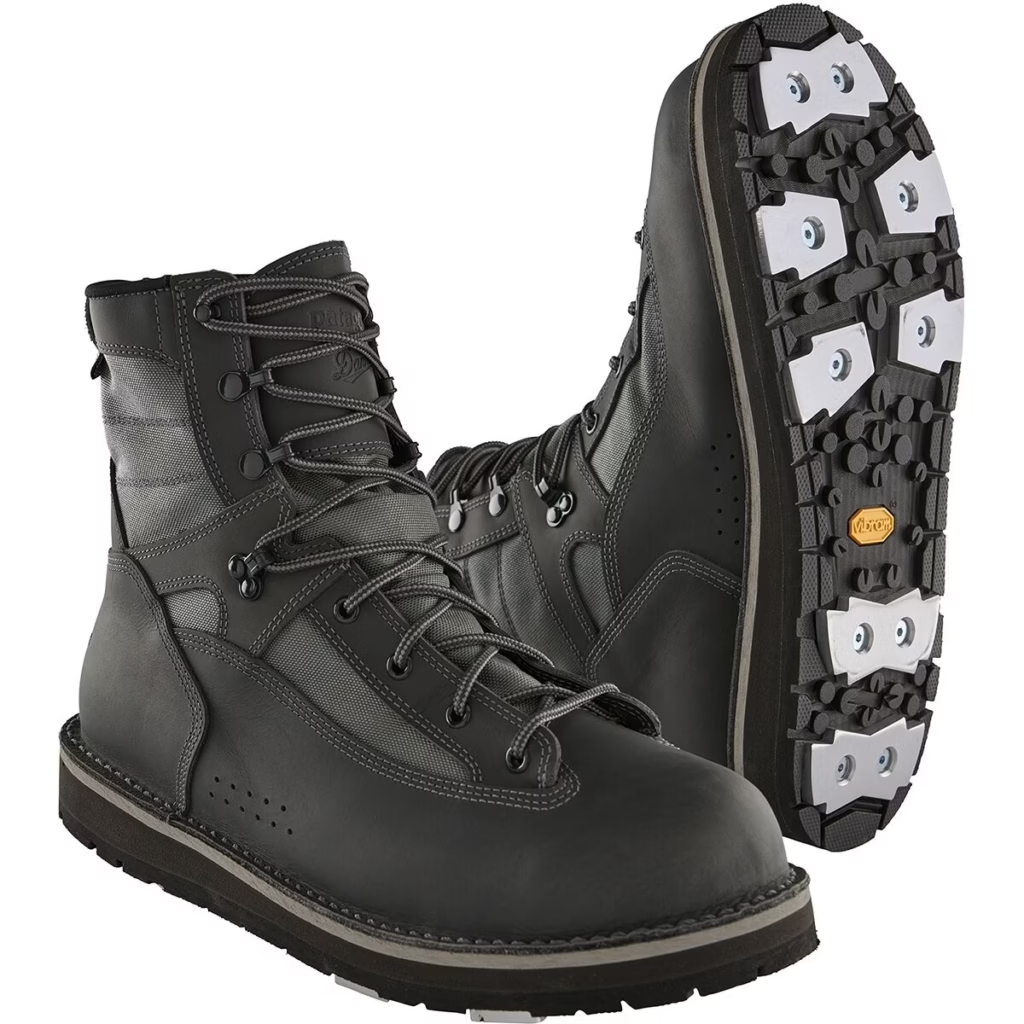
By all accounts, it had been a great year of fishing. My logbook listed just shy of 50 trips the previous year, excluding many half hour jaunts on my backyard pond to unwind after work. So, during my early spring gear tune-up and overhaul, it didn’t surprise me that my boots were in pretty sad shape.

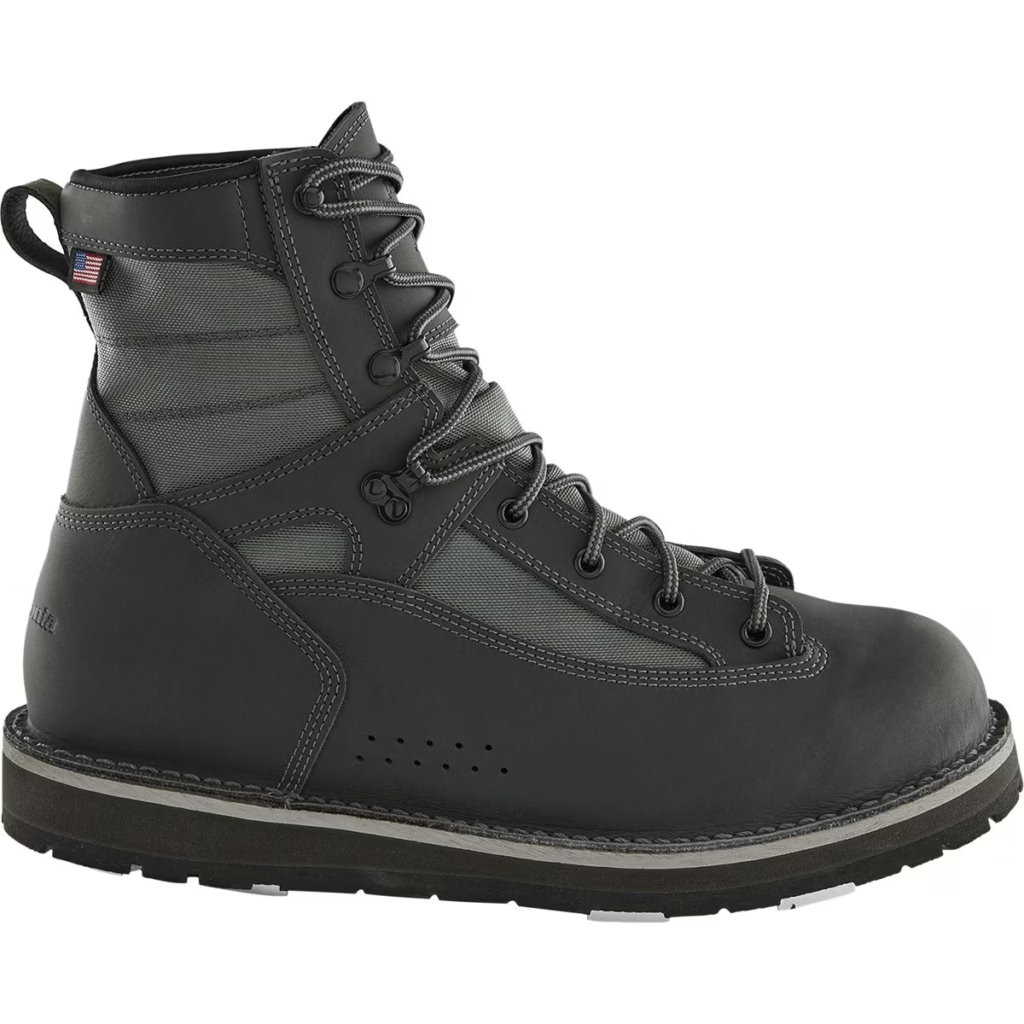
I contemplated, dare I say, putting them out to pasture. After all, I’d owned them since I started fly fishing some 10 years earlier. I bought them mainly for bass fishing in the rivers – a relatively inexpensive but classic design – and Hodgeman’s no less – still made in America back then. They’d served their master well, and the mantra of this throw-away society hummed away in my head as I looked them over. Those glossy catalogs of the big brand fly fishing purveyors sell a compelling story – faster, lighter, better, tougher…

Oh, the places they took me…

The fly rod may be the heart and soul of a fly fisherman, but its his boots – the workhorse – that get him where he needs to be. They take the most abuse – the lion’s share of wear and tear of all a fly fisher carries. They are rarely in the picture of the beaming fisherman holding up the bounty of the day’s trip. And at the end of the day the weary fisherman unceremoniously sheds them, and stows them out of the light, beneath his waders, the Rodney Dangerfield’s of the angler’s gear – not getting a whole lot of respect. But like the weathered hands of a farmer, a well-used pair of boots has a story. To anyone who sees them, they speak experience astream. And they get better with age – fit better and somehow feel better. So, for these reasons, and the outright economic prudishness these times demand, I reconsidered the death sentence I was about to hand down…

There’s an old shoe repair store on the mostly bypassed main street of my town. The stores that surround it are largely what you’d call mom and pop businesses. Some storefronts are shuttered looking for new owners, the victims of the big box retailers that now line the parkway to the east. This little place sits among them – a classic sign marking its existence. It is busier than one may think.

You won’t find Gucci here, but he could repair them…

So, I went there one day on lunch break, boots in one hand, new Hodgeman’s felts in the other. Inside, the place breathed leather, shoe polish, and glue. Behind the counter was a doorway, a window into the lonely world of the cobbler. In the back of the shop was a long workbench, shoe anvils, all types of tools – awls, picks, and mallets – and racks of laces, shoemakers stitching, and leather. To the left of the counter were the fruits of true craftsmanship – neatly set in racks, tags hanging with names of owners. Every shoe, boot, belt, and handbag was polished. I began to feel good.

Inside that door waits a true cobbler…

The cobbler soon emerged from the back, clad in a heavy leather apron, workshirt, and brimmed hat. His whole appearance, including the neatly trimmed beard covering his jaw, seemed Amish, though I couldn’t be sure, and his hands testified to his work ethic – rough, calloused, and black with polish. His demeanor was pleasant. He studied my boots, turning them in his big hands – pulling the tongue back, examining the sides.

That my boots needed to be re-soled was apparent. The felt was worn thin and, in some places, de-laminated from the boot bottoms. But it’s what I didn’t tell him that he seemed to focus on. “I can re-glue the inside sole”, he said. He continued examining my boots, noting how the stitching on the outer sides was frayed and, in some cases, parted. “I’ll re-stitch these here”, he added. We settled the particulars – I could pick them up in a week. He marked a tag with my name and phone number and set them in a rack of accumulating work. He asked where I fished. The Susquehanna he was not too familiar with – he had canoed a few local lakes, but not the rivers of the Southern Tier. So, for the next half hour I told him about the fishing – the big smallmouth bass, walleyes, channel cats, carp, and musky that could be caught, and then about the wildlife that could be seen – mergansers that flew like sea-skimming missiles up the river and the osprey that dove straight into the river like a rock dropped from the clouds and the eagles that cast big shadows where they flew, and the great blue herons that at a distance in the early morning mist looked like hunched old fisherman working a pool. All these things I had seen because of my boots.

A week later I returned – a sunny spring day full of promise. I picked up my boots, newly clad with bright white felts, neater in appearance, restitched, all put together, and ready for work. The fee was so nominal I can’t recall it now, but for the memories they’d bring me, I should have paid a hell of a lot more.

Coming to a river near you, the Flathead…

Mama always said, life is like a box of chocolates. You never know what you’re going to get.

Forrest Gump

While perusing Facebook one morning, I came across a picture that rather startled me in both a good and bad way. I’m a Facebook friend of long-time fishing guide, Lance Dunham, and in my feed was a report from a recent outing he made with clients. Typical of Lance were pictures of some very nice smallmouth bass, but there is always a smattering of other species mixed in. This is one reason I have always enjoyed fishing the Susquehanna and its tributaries: the diversity of species the river offers up. On any given day, one can tie into smallmouth bass, fallfish, northern pike, carp, channel catfish, walleye, rock bass, and musky. And Lance’s post proved you can now add another species: the flathead catfish. But whether this is a good or bad species to add to the list is up for speculation over the longer term.

A client of Lance Dunham, fishing guide, shows a flathead catfish caught in the Susquehanna, south of Towanda PA

The flathead catfish has been grabbing news headlines over the years in towns and cities around the lower Susquehanna River. In 2020, a 56 lb. fish was caught, establishing a Pennsylvania state record. 3 years later, the state record was broken again by a 66 lb. flathead caught in the Susquehanna near Conestoga, PA, roughly 30 miles southeast of Harrisburg.

The record-setting angler was fishing with a friend in a very deep channel of the river known as Lake Aldred. He had baited a live rainbow trout onto a large circle hook with a 1.5-ounce sinker. The pair had four lines in the water at once and it wasn’t long before they had 3 hook-ups – landing a 30 pounder, a 45 pounder, and finally the new state record fish.

The current Pennsylvania state record flathead catfish

The huge flathead catfish officially weighed 66 pounds and 6 ounces, exceeding the previous state record by more than 10 pounds and measured 50.25 inches long with a girth of 35 inches. To show just how large flatheads can grow, Pennsylvania’s record is just half the world record, set by a 123 lb. fish caught out of a reservoir in Kansas!

The fish was released alive by the Pennsylvania game warden certifying the record. I found it odd that the angler was using a gamefish for bait, but Pennsylvania allows the use of gamefish for bait as long as they are fished whole. More interesting was the fact that such a fish with a record of being “invasive” was released alive.

Turns out the topic of “invasive” is in itself confusing. The flathead catfish (Pylodictis olivaris) is native to the Mississippi River basin, which includes parts of western Pennsylvania—specifically the Ohio River drainage. So, while it’s native to the greater state of Pennsylvania, it’s only truly native to that western sliver of the state, and certainly not native to the Susquehanna River basin, where it was first detected in 1991. It has since spread rapidly.

Flathead catfish are apex predators, sitting at the top of the food chain. Once introduced to the Susquehanna River, they’ve begun reshaping the ecosystem in dramatic ways that include predation of native species such as smallmouth bass, channel catfish, baitfish, and even crayfish. Their presence also forces other species to change their diets and habitats to avoid competition or predation. Channel catfish, for example, feed lower on the food chain in areas where flatheads are present. And because of this broad dietary overlap, ecological balance can be affected. Smallmouth bass, channel catfish, and carp all feed on crayfish, making the flathead just one more “consumer” of that resource.

Pennsylvania is taking steps to manage this invasive species. There is no creel limit for flatheads, for example, and catfish is a good eating fish. While there is a creel limit for channel cats in Pennsylvania – 50 per day – New York has no creel limit. One has to wonder if at some point these limits will be adjusted due to the flathead’s predilection for eating anything that swims.

In addition to the absence of a creel limit, there is also no mandate that flatheads be killed, such as is the case for snakeheads in Pennsylvania, which must be both killed and reported. In waters like the Delaware and Susquehanna River basins, anglers are only encouraged not to release Flatheads, regardless of size.

The concern of the flathead’s opportunistic predation and its potential to decimate native and recreational fisheries has led a team of researchers from Penn State, the U.S. Geological Survey (USGS), and the Pennsylvania Fish and Boat Commission to assess how flatheads are affecting the food web and energy flow in the Susquehanna River in Pennsylvania.

Their research found that flatheads had the highest trophic position – the level an organism occupies in a food web, based on its feeding relationships – even higher than resident top predators such as smallmouth bass and channel catfish. Channel catfish had a lower trophic position in areas populated with flathead catfish. This means they had to eat lower in the food chain, likely because they are being outcompeted by flatheads or avoiding them. In areas with flathead catfish, they also found all species showed broader and overlapping diets.

The research suggests that resident species are changing what they eat to avoid competing with or being eaten by the invader. The research also supports the ‘trophic disruption hypothesis,’ that says when a new predator enters an ecosystem, it forces existing species to alter their behavior, diets and roles in the food web. This can destabilize ecosystems over time. The study highlights how an invasive species can do more than just reduce native populations – it can reshape entire food webs and change how energy moves through ecosystems.

In addition to evaluating trophic position, the researchers also analyzed the isotopic niche occupied by the fish species – the range of carbon and nitrogen markers found within the tissues of an organism, reflecting its diet and habitat, providing insights into its ecological role.

To reach their conclusions, the researchers employed stable isotope analysis, a widely used tool that can explain patterns within a food web, highlighting links between trophic positions, as well as the breadth and overlap of trophic niches.

When fish eat, their bodies incorporate the isotopic signature of their food. By sampling their tissues, scientists can measure nitrogen isotopes and determine their diet, carbon isotopes to determine habitat use, and compare isotopic signatures across regions to deduce fish migration or habitat shifts. For this study, channel catfish, smallmouth bass, minnows and crayfish were selected as focal species because a previous diet analysis conducted in collaboration with Penn State, USGS, and Pennsylvania Fish and Boat Commission researchers within the Susquehanna River, showed that these species are important prey for flathead catfish.

“Flatheads grow fast in this river system, attain large body sizes and can eat a variety of prey,” said study author Olivia Hodgson, a master’s degree student at Penn State University. “Because adult flatheads have few natural predators, flathead catfish can exert strong control over the ecosystem.”

But invasives are nothing new. Zebra mussels, carp, Didymo, hydrilla, rusty crayfish, gobies – our waters have weathered all manner of invasives with different results. The St. Lawrence is one system hugely impacted by zebra mussels. I can recall fishing there in the 90’s when pike were plentiful in vast aquatic weed beds. Zebra mussels changed all of that – the water is now crystal clear, favoring smallmouth bass and diminishing northern pike populations.

I had the opportunity to discuss the invasion of the flathead during an outing with guide local guide Jimmy Kirtland of Row Jimmy’s guide service. Kirtland guides on the Susquehanna and other local rivers for smallmouth bass, channel catfish, and musky. His response to whether flatheads will truly change the fishing was muted, saying there is often a lot of anxiety to the news of invasives, but things tend to work themselves out in the long run and not become the environmental disasters that were originally feared.

The primary method of catching flathead on rod and reel is using live or cut bait. Flatheads are very different from channel catfish. They have relatively small eyes whereas channel catfish have large eyes.

The beady eyes of a flathead…

And flatheads, especially the large ones, prefer live bait, and less so dead or even the stinky kinds of baits used for channel catfish. They prefer to feed at night but can be caught during the day around submerged structure, especially wood snags. The larger fish tend to be loners and will be very aggressive towards any fish, including their own.

But can they be caught on a lure or better yet, the fly? The fact that Lance Dunham’s clients are catching them is evidence of their taking a lure. But the fly? The answer is yes and I didn’t have to look far on the internet to find that answer. Flylords Mag featured an account of an outing by two anglers in eastern North Carolina. While sight fishing for longnose gar on a local river in low, clearwater conditions, these anglers stumbled upon a group of flatheads…

My buddy was in front of me and reached the pool we had in mind first, and yelled that there were 4 or 5 GIANT CATFISH. I didn’t realize how big he meant until I caught up with him and looked where he was pointing. These absolute giants were congregated and slowly cruising around at the top of the hole, and we both started freaking out. I had broken my 9wt earlier in the week and was using my 8wt with a slightly sinking tip. I tied on an EP brush fiber & deer hair gamechanger fly I tied the night before. I cast to the closest fish and just hovered it in front of its face, with a few short and abrupt strips. I immediately froze for a moment as I saw its mouth open and engulf the fly. The fish kind of turned in confusion for a slight second and shot downstream as it realized it was hooked.

Fly angler Andy Howard cradling a river monster…

I held on to my rod and barreled downstream after it, tearing my legs up in the process. I knew this was the biggest catfish I’d ever hooked and my mind was just racing. The pools are closely connected and are very deep so I had to plan on where to step accordingly. This didn’t really work out as I fell many times just to keep up with this fish, but I didn’t care. It seriously felt like I had hooked into a truck, and I was the one being controlled. I get crap constantly from my buddy’s because I use straight 35-pound mono as my short leader (for toothy gar and bowfin) but I was glad I didn’t have anything less than it on. I truly did not think I was going to land this fish because for every inch I got on him, he took back two feet or more. At the bottom of the third or fourth massive pool, the catfish realized it couldn’t go any further downstream as the river started to shallow up, and decided it was heading back upstream. I obliged. After a fight close to 45 minutes, and when fish was finally growing tired I managed to guide it into one of the open rock crevice areas where I felt I could most safely unhook it and admire it.

To pursue these fish on the fly, think very large flies with lots of movement, fished deep in snaggy structure by day and in shallower areas adjacent to holding water at night. Gear would need to be of the salty type – a 9 – 11 weight fly rod, big reels spooled with lots of backing and depending on the depth fished, intermediate to sinking fly line and a heavy, 30 pound-plus, short leader.

It’s likely that guide Lance Dunham’s future fishing reports will include more flatheads being caught, but will the smallmouth bass make less of an appearance going forward? As a long-term fly angler of the Susquehanna and its smaller tributary rivers, I’m never disappointed when I run into channel catfish. While I’d hate to see the balance that exists now shift largely in favor of “the invader”, the thought of hooking up with one of these river monsters on the fly sings a siren’s song…

Say hello to Finn!

Your dog is part of your world, but to a dog, you are their whole world…

As I write this on Christmas day, there’s warmth at my feet radiating from an 8-week-old male chocolate lab out of Peak Performance Labradors, snoozing the morning away. “Finn” came into this world on October 29th, one of 10 labrador retriever puppies, a mix of 5 black males, 3 chocolate females, and 2 chocolate males. We had the pick of the two chocolate males and chose “green (collar)” over “brown (collar).” “Green” was second biggest of the litter; his paws show it and at 8 weeks old he is weighing in at over 12 pounds. It’s likely he will be a big boy. His name is a play on his future.

Finn…

Finn is the product of a fine pedigree – both his father, “Tommy” (Grampian’s Pin Ball Wizard, S H) and his mother, “Jade” (Peak’s Stone in Love, JH), have hunting titles, and excellent health credentials, the most important for a lab being their OFA Hip rating, in their case, both being rated excellent.

“Tommy” – Grampian’s Pin Ball Wizard, SH

The breed has a history of hip dysplasia which responsible breeders try to breed out by identifying dogs that have poor hip ratings and not breeding them.

“Jade” – Peak’s Stone in Love, JH

Bringing Finn into the family comes on the heels of losing our Maddie last November, who we had to put down at 12 years of age due to bad arthritis. Maddie’s beginnings were worlds apart from Finn’s. We adopted Maddie from Every Dog’s Dream in Greene, NY, where she was fostered after arriving from a high-kill shelter in Darlington, SC. The shelter reached out to Every Dog’s Dream trying to place Maddie and her three brothers, and Every Dog’s Dream responded by taking all 4 puppies.

Maddie’s breeding was a unique majority blend of a treeing walker coonhound and lab, with a bunch of other minor “contributors” including Beagle, German shepherd, pit bull, and Dalmatian according to genetic testing we had done. We suspect Maddie and her 3 brothers may have been culled out of a litter destined for some sort of hunting, though she had very high prey drive in my opinion, so I’ll never be sure what disqualified her. She loved to chase squirrels, chipmunks and rabbits.

Maddie sniffing out a red squirrel. Note her hound-like profile yet the presence of many lab features…

Maddie was a true joy to own – extremely friendly to her humans, loyal, protective, and never an accident in our home. Having spent most of my life with dogs made it very hard not to fill the void left after Maddie’s passing. Now that void’s been filled with a beautiful lab puppy, bubbling with love and boundless energy.

Finn will love it here on the shores of Lake Ontario. Just 30 feet out the back of our house is that Great Lake, while in front, across the street, is the outlet from Long Pond into the lake.

Long Pond, looking south from Edgemere Drive. The pond is over 440 acres in area.

In addition to Long Pond, just up and down the road along the lake shore are Buck Pond, Cranberry Pond, Round Pond and Braddock Bay.

The Braddock Bay Wildlife Management Area (WMA) – vast marshland, woods, and ponds. A watery world built for a labrador retriever…

The Braddock Bay WMA is over 2,000 acres of rich and diverse marshland, ponds and shoreline habitat and is on the Atlantic Flyway and therefore the home of year-round avian residents as well as a resting spot for migrating birds, waterfowl in particular.

Ducks of every kind abound here, including:

  1. Dabblers (shallow-water feeders): Mallards, Black Ducks, Gadwalls, Northern Pintail, American Wigeon, Blue-winged Teal, Green-winged Teal, Northern Shoveler, and Wood Duck.
  2. Diving ducks (open water and deeper bays): Greater and Lesser Scaup. Goldeneye, Bufflehead, Redhead, Canvasback, Ring-necked Duck, Ruddy Duck, Hooded, Common, and Red-breasted Merganser.
  3. Sea ducks (Lake Ontario proper): Long-tailed Duck (Old Squaw), White-winged Scoter, Surf Scoter and Black Scoter.

The parks in the area are ringed with miles of trails that skirt the vast marshland. These will be well worn by Finn and me in the coming years.

As his name implies, Finn will be a future fly-fishing companion, wading local inland streams, rivers, and Great Lakes tributaries, as well as accompanying me in a boat fishing the ponds and lake shoreline. And that role is fitting, given the origins of the Labrador Retriever.

The perfect fly-fishing companion…

Labrador retrievers are descendants of the St John’s Water Dog, an extinct landrace of domestic dog from Newfoundland. Little is known of the types that went into its genetic makeup, although it was probably a random-bred mix of old English, Irish and Portuguese working dogs. These were favorite dogs of fishermen due to their good temperament, cold weather ruggedness, and high work drive.

The St. John’s breed was called “water dog” because of their love for water. They were medium-sized, strong, and stocky, with a highly water-resistant coat and more closely resembled modern Show Labradors (English) than Field Labradors (American).

A pictorial comparison of the English (show) labrador versus the American (field) labrador. Both can actually be shown under the AKC Breed Conformance Standard, and both can do field work. The English type is said to be a little more laid back and less energetic while the American type is more athletic and has higher field drive.

Our Finn is an American or field labrador as are all the dogs out of Peak Performance Labrador’s line.

Writings as early as the 17th century mention hardy medium-sized black dogs (the original color) that accompanied Newfoundland fishermen in their boats, and retrieved distant lines, nets of fish and even escaped fish, hauling them back to the boat.

The St. John’s Water Dog

During the 19th and early 20th centuries, St. John’s water dogs were exported from Newfoundland to England where they were crossbred with other dogs to create the modern retrievers, including the Labrador Retriever.

Beyond fishing duty for Finn, there’s always the lure of taking up bird hunting – either upland birds or waterfowl – as Labradors are adept at both types, as well as the possibility of therapy dog work.

But most of all, Finn will surely follow in the pawprints of his predecessor, Maddie, being as good a companion as any human could ask for…

On the road with Finn, heading to his forever home…

The Last Good Country – 2025

Onto the river I must go, to lose my mind and find my soul.

John Muir

I was awoken by a text alert at 1:30 am, the morning of my fly-fishing trip to the Bighorn River in southeastern Montana. I stared bleary-eyed at the message – my flight from Chicago to Billings was going to depart late due to a crew rest requirement. OK, I thought – not an issue – more layover time for my bags and I was to be the first of our group of four to arrive at the Billings airport anyhow. But then I noticed another earlier text that read “your flight to Chicago O’Hare has been cancelled.” Some expletives followed that reading, along with an early scramble to find another flight.

After hours on hold trying to reach an agent, I was finally able to book a flight, but I’d get in on Monday evening instead of Sunday and miss a full day of our three-day fishing trip. I considered cancelling the trip, especially when faced with the fact that my re-booked flight would have two connections, not the original one. In the end, the other three in our party and my family convinced me to make it, albeit late. As it turns out, I’m glad I did.

One often wishes for fishing circumstances to align like the stars and planets and sometimes they do. For this trip, the hopper hatch, when clumsy grasshoppers get blown off the bankside bluffs creating a chum line for big rainbows and browns, never happened, nor did the Trico hatch where fine tippet and number 20 and 22 dries and emergers are the rule. On my last Bighorn trip, my brother-in-law and I enjoyed incredible Trico dry fly fishing to large meandering pods of browns, snouts up and gorging on spinners with reckless abandon. Instead, this trip would be a pure nymphing game, which I was just fine with, thank you very much.

Our party consisted of my brother-in-law, Jeff, who had introduced me to fly fishing way back in 1998, Kent, a sales exec who worked with Jeff back in the day and who I’d fished with on our last trip, and Dan, a work colleague of mine and another fine fly fisherman who I’d fished with in Southern Tier waters on occasion.

The Bighorn gang of 4 – Dan (foreground), Jeff back left, Kent back middle, and yours truly back right…

We had the run of the Old Hooker’s Guesthouse, each with our own bedroom and bath. I’d stayed in the place on the previous trip and found it very comfortable and big enough to host entire families, having a recreation room, living room, full kitchen and dining room.

Old Hooker’s Guesthouse

Another great feature of the guesthouse was the lower-level utility room and rod room. The rod room opened to a lower deck area. It was nice to be able to gear up and gear down in this big space, set boots and wading socks to dry outside, clean and stow rods and equipment, and amble upstairs

The rod room…

We had two guides for the four of us – two anglers to a drift boat. They were Ian, who I had never fished with, and Ryan, who I had fished with in my inaugural trip to the Bighorn in 2007. I already knew Ryan to be a great guide and was excited with the prospect of fishing with him again.

The main hatches at the time of our trip were PMD’s and black caddis, with some tan caddis and pseudos about at times. Though not a hatch in the proper sense, ever ubiquitous in the Bighorn are sowbugs and aquatic worms. Indeed, in the lower sections of the river we would occasionally land a fish with a lot of “salad” about the leader and that vegetation would be teeming with sowbugs. We did fish with sowbug nymphs and aquatic worms at times.

Both Ian and Ryan removed our leaders and built their own at the start of each day. The leaders were pretty basic – another guide thing – easy to tie and a lot stouter than I thought they would be, being made up of equal lengths of 20 lb., 15 lb., and 10 lb., leader material with a swivel on the terminal end. Ian molded lead putty over the swivel whereas Ryan used split shot above the swivel. Attached to the swivel would be two additional lengths of tippet – in Ian’s rig these were 10 lb. flouro – in Ryan’s set-up they were 8 lb. flouro – with a pair of nymphs. The tail nymph was tied on with an improved clinch knot, but the lead nymph was either tied through the eye or, in the case of Ryan, run off a short tag. Much like my previous two trips, both guides used small white balloons for indicators. These makeshift indicators are both sensitive and cheap – a fitting substitute for “proper” indicators on a guide’s budget.

Under Ian’s guideship, Dan and I started the day fishing black caddis nymphs, one which I confirmed to be the infamous poodle sniffer. We would not change flies much during our float with Ian, though later in the day he did rig up “the worm” above the deadly poodle sniffer. The worm was rigged much like a pegged bead.

Ryan also stuck to the tried-and-true poodle sniffer, but the tail nymph was a small bead-head black caddis nymph of Ryan’s own design – more or less a black pheasant tail with some black/purple flash as I recall in a size 16 or 18. That fly produced remarkably well.

With the heat being what it was, we enjoyed a gentleman’s start to each day, meeting the guides outside the guesthouse around 9 am. I was expecting differently but as Jay Peck, a well-known guide in New York often says, “we fish to the fish’s schedule, not our own.” Such was the case here – the late start allowing the heat to do its work on the cold tailwater release water of the Bighorn, prompting increased bug activity. I think as a group we all liked the late start. On the previous trip we’d be up well before sunrise in order to fish the trico spinner fall at daybreak, so it was a nice change to “sleep-in.”

Jeff, Kent, and I assembled in the kitchen around 7 each morning, slurping good coffee in the quiet of the dawn. Dan, on the other hand would emerge late and so earned the nickname, “Rip”, as in Rip Van Winkle. Dan seemed to melt away early after dinner and was the morning laggard, prompting all manner of theories regarding the amount of sleep he needed or where else he might be…

Dan, aka “Rip”, awake enough to land this nice Bighorn brown…

We launched at the YellowTail after-dam access both days and fished the three miles to the 3-mile Access takeout. There are, in total, 13 miles of the Bighorn to float but the highest density of trout is in the first 3 miles. Of course, along with that comes more boats and fishing pressure. Drifting from 3 mile to the 13-mile take-out provides more solitude but a lower density of fish, though I’ve heard there are more giants in the mix.

The Yellowtail After-Dam Access…

Almost immediately after launching we were instructed to cast by the guide – “ok, boys, to the right” or to the left as the case may be. Though paddling upriver to keep us at current speed, both guides would watch our indicators and call-out if we missed a hookset. Even early on, the hook-up pace was decent, but by late morning, the fishing got better and better, building to a crescendo of activity as the hatch progressed.

An “average” brown…
Ryan Stefek holds an “average” rainbow before release. We caught a bunch bigger. I fished a Cortland Competition Nymph 10’6″ 4 weight rod which did fine, but Ryan felt the tip was too soft when these strong fish were ready for landing. Next year I’ll build a 10-foot 6 weight for the job…
Dan with a rainbow so chrome we thought it was a steelhead…

In typical trout fashion, the browns bulldogged hard, occasionally jumping, while the rainbows fought with drag-screaming runs and frequent acrobatics. The whitefish, which we caught in the mix, did their best but had less game in their fight compared to their trouty brothers.

A buck rainbow in deep color contrast…

I think everyone lost count of the many browns and rainbows we caught with a few whitefish in the mix. It was basic “indie” fishing – cast slightly ahead, mend to the speed of the drift, and set on any movement of the indicator.

Guide Ian holds up a beauty of a brown caught by yours truly…

I landed a true unicorn rainbow. According to guide Ian, it was likely a cutbow, a rainbow / cutthroat hybrid…

A unicorn cutbow – note the cutthroat red under the gill plate and the orange splashes on this gorgeous specimen!
Jeff with a very nice rainbow, and look at those blush red cheeks!
Jeff with a fat, colored-up rainbow…
Kent with a big leopard spotted rainbow
Kent with a green-backed hen…

Double hook-ups were common on our trip under Ian and Ryan’s guideship. Ryan was a master of the “spin-o-rama” as he called it. If the bow position angler picked up a fish, he’d spin the boat around, allowing the stern angler to have a bow shot at another fish while the bow angler fought his fish astern.

Ryan Stefek expertly executing his spin-o-rama. In this pic, Ryan is at the oars pivoting the bow upstream as I fight a fish (left), giving Dan (to the right in the stern) a chance to fish his rig for a double…

The action could be frantic at times. One of the most memorable catches for me was when Jeff and I doubled up and Ryan simultaneously netted our big identical twin rainbows…

Each day our guides would stake out a certain shady retreat at the side of the river for lunch. The work of a guide is as much timing as it is fishing – we’d drift the river not realizing the guide was timing the drift to arrive at this spot where we could raft our two boats and anchor to enjoy lunch in the shade and out of the unrelenting blistering sun…

Yours truly enjoying lunch under the shade of a Russian olive tree. Ian, our guide, is seated talking guide stuff with Ryan.

Besides the fantastic fishing, there are always other aspects of this trip that make each one so memorable. I missed the labs that Stretch (Jim) and Joyce had around on our last trip – hearty and joyful labs – crazy about retrieving anything we winged out in their backyard. There’s a great pic of Stretch fly fishing the Bighorn with one of his labs pinned to his side, ever alert. Now that’s a fly-fishing dog!

One morning, as we assembled around our guides and their boats, Stretch drove up to deliver the lunches to our guides, accompanied by a beautiful old yellow lab named Boomer. He was a rescue and according to Stretch in really bad shape when he and Joyce picked him up and nursed him back to life.

Eastslope Outfitters not only offers guided fly fishing but also hunting trips for big game such as elk and mule deer as well as waterfowl and upland birds.

A happy Eastslope hunter and some of Stretch’s labs…

The weather for this trip was a string of identically hot days with clear skies and little wind. The days warmed quickly and by mid-day temperatures climbed into the high 90’s. It was dry heat, and certainly wet wading weather, though we only waded when we left the drift boat for bio breaks or just to get wet and cool off. The river temperature was likely in the low 60’s and very refreshing. This weather was the same we had experienced on the last trip, but Montana weather, even in late summer, can be horribly fickle. On that last trip, an Arctic cold front swept across the state and daytime highs plummeted from the 90’s to the low 40’s with rain and high wind. The surrounding mountains were capped with snow. I packed for this trip accordingly with waders, layers, a rain jacket, fingerless gloves and a warm hat though they never were needed. Be prepared for anything is wise counsel if fishing in Montana, particularly in late summer / early fall.

I’d be remiss in not mentioning the epicurean delights we feasted on during our stay. Because of my delayed arrival, I missed out on Stretch’s famous venison meatloaf. Meatloaf and gravy certainly qualify as wohlfühlessen, the German word for comfort food: better yet it makes for a great shore lunch sandwich. Alas, it was not to be for me on this trip.

The other meals were maple-glazed salmon on the grill, tasty BBQ chicken thighs, and for “the last supper”, grilled tri-tip beef, perfectly done. Each main course was accompanied by veggies and a starch. Prior to diving in, we were treated with outstanding salads freshly made by Jenna, Stretch’s culinary twin in the kitchen.

Stretch could do very well opening a side deli business. His sandwiches were primo and thick enough to choke a horse. I liked the touches of spicy relishes, mustard, and other condiments. All came with a salad, fruit, or coleslaw, chips, and cookies.

Damn good…

While the days were hot, the evenings were wonderfully cool. After a delicious meal, we’d gather on the lawn in comfortable chairs, smoke a cigar or drink a bourbon or beer, and look up to the star-studded night sky. Satellites streaked across the heavens along with the occasional shooting star. The quiet of the evening was deafening in its own way.

Cowboy boots and old wading boots adorned the fenceposts around the lodge.

As we closed our last day, we recounted the fishing and the size of the fish we caught, which is known amongst fly fishers to grow with time. But truly one of the high points was a comment Dan made. On the last day of our trip, he floated with Kent and asked guide Ian how he’d rate us as fly anglers. Ian’s response: A+. That meant more to me than the fishing itself.

I left that good place with sore forearms, a testament to the strength of the rainbows and browns that call the fertile Bighorn River home. We all departed Montana on our separate ways – Dan to southeastern Pennsylvania, Jeff and Kent to the Bay area of California, and me to Rochester, NY. And as with my previous two trips, the desire to return to that last good country was greater than ever. I know Dan, Jeff, and Kent would agree.

Side note, my trip home was flawless including early landings. Figures…

« Older posts