Onto the river I must go, to lose my mind and find my soul.
John Muir
I was awoken by a text alert at 1:30 am, the morning of my fly-fishing trip to the Bighorn River in southeastern Montana. I stared bleary-eyed at the message – my flight from Chicago to Billings was going to depart late due to a crew rest requirement. OK, I thought – not an issue – more layover time for my bags and I was to be the first of our group of four to arrive at the Billings airport anyhow. But then I noticed another earlier text that read “your flight to Chicago O’Hare has been cancelled.” Some expletives followed that reading, along with an early scramble to find another flight.
After hours on hold trying to reach an agent, I was finally able to book a flight, but I’d get in on Monday evening instead of Sunday and miss a full day of our three-day fishing trip. I considered cancelling the trip, especially when faced with the fact that my re-booked flight would have two connections, not the original one. In the end, the other three in our party and my family convinced me to make it, albeit late. As it turns out, I’m glad I did.
One often wishes for fishing circumstances to align like the stars and planets and sometimes they do. For this trip, the hopper hatch, when clumsy grasshoppers get blown off the bankside bluffs creating a chum line for big rainbows and browns, never happened, nor did the Trico hatch where fine tippet and number 20 and 22 dries and emergers are the rule. On my last Bighorn trip, my brother-in-law and I enjoyed incredible Trico dry fly fishing to large meandering pods of browns, snouts up and gorging on spinners with reckless abandon. Instead, this trip would be a pure nymphing game, which I was just fine with, thank you very much.
Our party consisted of my brother-in-law, Jeff, who had introduced me to fly fishing way back in 1998, Kent, a sales exec who worked with Jeff back in the day and who I’d fished with on our last trip, and Dan, a work colleague of mine and another fine fly fisherman who I’d fished with in Southern Tier waters on occasion.

We had the run of the Old Hooker’s Guesthouse, each with our own bedroom and bath. I’d stayed in the place on the previous trip and found it very comfortable and big enough to host entire families, having a recreation room, living room, full kitchen and dining room.

Another great feature of the guesthouse was the lower-level utility room and rod room. The rod room opened to a lower deck area. It was nice to be able to gear up and gear down in this big space, set boots and wading socks to dry outside, clean and stow rods and equipment, and amble upstairs

We had two guides for the four of us – two anglers to a drift boat. They were Ian, who I had never fished with, and Ryan, who I had fished with in my inaugural trip to the Bighorn in 2007. I already knew Ryan to be a great guide and was excited with the prospect of fishing with him again.
The main hatches at the time of our trip were PMD’s and black caddis, with some tan caddis and pseudos about at times. Though not a hatch in the proper sense, ever ubiquitous in the Bighorn are sowbugs and aquatic worms. Indeed, in the lower sections of the river we would occasionally land a fish with a lot of “salad” about the leader and that vegetation would be teeming with sowbugs. We did fish with sowbug nymphs and aquatic worms at times.
Both Ian and Ryan removed our leaders and built their own at the start of each day. The leaders were pretty basic – another guide thing – easy to tie and a lot stouter than I thought they would be, being made up of equal lengths of 20 lb., 15 lb., and 10 lb., leader material with a swivel on the terminal end. Ian molded lead putty over the swivel whereas Ryan used split shot above the swivel. Attached to the swivel would be two additional lengths of tippet – in Ian’s rig these were 10 lb. flouro – in Ryan’s set-up they were 8 lb. flouro – with a pair of nymphs. The tail nymph was tied on with an improved clinch knot, but the lead nymph was either tied through the eye or, in the case of Ryan, run off a short tag. Much like my previous two trips, both guides used small white balloons for indicators. These makeshift indicators are both sensitive and cheap – a fitting substitute for “proper” indicators on a guide’s budget.
Under Ian’s guideship, Dan and I started the day fishing black caddis nymphs, one which I confirmed to be the infamous poodle sniffer. We would not change flies much during our float with Ian, though later in the day he did rig up “the worm” above the deadly poodle sniffer. The worm was rigged much like a pegged bead.
Ryan also stuck to the tried-and-true poodle sniffer, but the tail nymph was a small bead-head black caddis nymph of Ryan’s own design – more or less a black pheasant tail with some black/purple flash as I recall in a size 16 or 18. That fly produced remarkably well.
With the heat being what it was, we enjoyed a gentleman’s start to each day, meeting the guides outside the guesthouse around 9 am. I was expecting differently but as Jay Peck, a well-known guide in New York often says, “we fish to the fish’s schedule, not our own.” Such was the case here – the late start allowing the heat to do its work on the cold tailwater release water of the Bighorn, prompting increased bug activity. I think as a group we all liked the late start. On the previous trip we’d be up well before sunrise in order to fish the trico spinner fall at daybreak, so it was a nice change to “sleep-in.”
Jeff, Kent, and I assembled in the kitchen around 7 each morning, slurping good coffee in the quiet of the dawn. Dan, on the other hand would emerge late and so earned the nickname, “Rip”, as in Rip Van Winkle. Dan seemed to melt away early after dinner and was the morning laggard, prompting all manner of theories regarding the amount of sleep he needed or where else he might be…

We launched at the YellowTail after-dam access both days and fished the three miles to the 3-mile Access takeout. There are, in total, 13 miles of the Bighorn to float but the highest density of trout is in the first 3 miles. Of course, along with that comes more boats and fishing pressure. Drifting from 3 mile to the 13-mile take-out provides more solitude but a lower density of fish, though I’ve heard there are more giants in the mix.

Almost immediately after launching we were instructed to cast by the guide – “ok, boys, to the right” or to the left as the case may be. Though paddling upriver to keep us at current speed, both guides would watch our indicators and call-out if we missed a hookset. Even early on, the hook-up pace was decent, but by late morning, the fishing got better and better, building to a crescendo of activity as the hatch progressed.


In typical trout fashion, the browns bulldogged hard, occasionally jumping, while the rainbows fought with drag-screaming runs and frequent acrobatics. The whitefish, which we caught in the mix, did their best but had less game in their fight compared to their trouty brothers.

I think everyone lost count of the many browns and rainbows we caught with a few whitefish in the mix. It was basic “indie” fishing – cast slightly ahead, mend to the speed of the drift, and set on any movement of the indicator.

I landed a true unicorn rainbow. According to guide Ian, it was likely a cutbow, a rainbow / cutthroat hybrid…


Double hook-ups were common on our trip under Ian and Ryan’s guideship. Ryan was a master of the “spin-o-rama” as he called it. If the bow position angler picked up a fish, he’d spin the boat around, allowing the stern angler to have a bow shot at another fish while the bow angler fought his fish astern.

The action could be frantic at times. One of the most memorable catches for me was when Jeff and I doubled up and Ryan simultaneously netted our big identical twin rainbows…

Each day our guides would stake out a certain shady retreat at the side of the river for lunch. The work of a guide is as much timing as it is fishing – we’d drift the river not realizing the guide was timing the drift to arrive at this spot where we could raft our two boats and anchor to enjoy lunch in the shade and out of the unrelenting blistering sun…

Besides the fantastic fishing, there are always other aspects of this trip that make each one so memorable. I missed the labs that Stretch (Jim) and Joyce had around on our last trip – hearty and joyful labs – crazy about retrieving anything we winged out in their backyard. There’s a great pic of Stretch fly fishing the Bighorn with one of his labs pinned to his side, ever alert. Now that’s a fly-fishing dog!

One morning, as we assembled around our guides and their boats, Stretch drove up to deliver the lunches to our guides, accompanied by a beautiful old yellow lab named Boomer. He was a rescue and according to Stretch in really bad shape when he and Joyce picked him up and nursed him back to life.

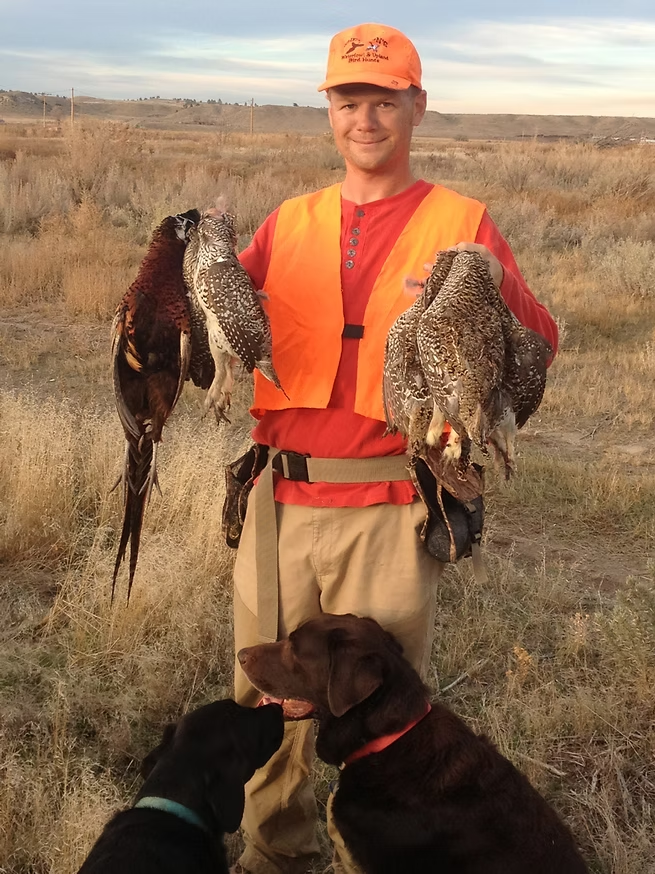
Eastslope Outfitters not only offers guided fly fishing but also hunting trips for big game such as elk and mule deer as well as waterfowl and upland birds.
The weather for this trip was a string of identically hot days with clear skies and little wind. The days warmed quickly and by mid-day temperatures climbed into the high 90’s. It was dry heat, and certainly wet wading weather, though we only waded when we left the drift boat for bio breaks or just to get wet and cool off. The river temperature was likely in the low 60’s and very refreshing. This weather was the same we had experienced on the last trip, but Montana weather, even in late summer, can be horribly fickle. On that last trip, an Arctic cold front swept across the state and daytime highs plummeted from the 90’s to the low 40’s with rain and high wind. The surrounding mountains were capped with snow. I packed for this trip accordingly with waders, layers, a rain jacket, fingerless gloves and a warm hat though they never were needed. Be prepared for anything is wise counsel if fishing in Montana, particularly in late summer / early fall.
I’d be remiss in not mentioning the epicurean delights we feasted on during our stay. Because of my delayed arrival, I missed out on Stretch’s famous venison meatloaf. Meatloaf and gravy certainly qualify as wohlfühlessen, the German word for comfort food: better yet it makes for a great shore lunch sandwich. Alas, it was not to be for me on this trip.
The other meals were maple-glazed salmon on the grill, tasty BBQ chicken thighs, and for “the last supper”, grilled tri-tip beef, perfectly done. Each main course was accompanied by veggies and a starch. Prior to diving in, we were treated with outstanding salads freshly made by Jenna, Stretch’s culinary twin in the kitchen.
Stretch could do very well opening a side deli business. His sandwiches were primo and thick enough to choke a horse. I liked the touches of spicy relishes, mustard, and other condiments. All came with a salad, fruit, or coleslaw, chips, and cookies.

While the days were hot, the evenings were wonderfully cool. After a delicious meal, we’d gather on the lawn in comfortable chairs, smoke a cigar or drink a bourbon or beer, and look up to the star-studded night sky. Satellites streaked across the heavens along with the occasional shooting star. The quiet of the evening was deafening in its own way.

As we closed our last day, we recounted the fishing and the size of the fish we caught, which is known amongst fly fishers to grow with time. But truly one of the high points was a comment Dan made. On the last day of our trip, he floated with Kent and asked guide Ian how he’d rate us as fly anglers. Ian’s response: A+. That meant more to me than the fishing itself.
I left that good place with sore forearms, a testament to the strength of the rainbows and browns that call the fertile Bighorn River home. We all departed Montana on our separate ways – Dan to southeastern Pennsylvania, Jeff and Kent to the Bay area of California, and me to Rochester, NY. And as with my previous two trips, the desire to return to that last good country was greater than ever. I know Dan, Jeff, and Kent would agree.
Side note, my trip home was flawless including early landings. Figures…
Recent Comments