One angler's journey, fly fishing through life

Tag: last good country

The Last Good Country – 2025

Onto the river I must go, to lose my mind and find my soul.

John Muir

I was awoken by a text alert at 1:30 am, the morning of my fly-fishing trip to the Bighorn River in southeastern Montana. I stared bleary-eyed at the message – my flight from Chicago to Billings was going to depart late due to a crew rest requirement. OK, I thought – not an issue – more layover time for my bags and I was to be the first of our group of four to arrive at the Billings airport anyhow. But then I noticed another earlier text that read “your flight to Chicago O’Hare has been cancelled.” Some expletives followed that reading, along with an early scramble to find another flight.

After hours on hold trying to reach an agent, I was finally able to book a flight, but I’d get in on Monday evening instead of Sunday and miss a full day of our three-day fishing trip. I considered cancelling the trip, especially when faced with the fact that my re-booked flight would have two connections, not the original one. In the end, the other three in our party and my family convinced me to make it, albeit late. As it turns out, I’m glad I did.

One often wishes for fishing circumstances to align like the stars and planets and sometimes they do. For this trip, the hopper hatch, when clumsy grasshoppers get blown off the bankside bluffs creating a chum line for big rainbows and browns, never happened, nor did the Trico hatch where fine tippet and number 20 and 22 dries and emergers are the rule. On my last Bighorn trip, my brother-in-law and I enjoyed incredible Trico dry fly fishing to large meandering pods of browns, snouts up and gorging on spinners with reckless abandon. Instead, this trip would be a pure nymphing game, which I was just fine with, thank you very much.

Our party consisted of my brother-in-law, Jeff, who had introduced me to fly fishing way back in 1998, Kent, a sales exec who worked with Jeff back in the day and who I’d fished with on our last trip, and Dan, a work colleague of mine and another fine fly fisherman who I’d fished with in Southern Tier waters on occasion.

The Bighorn gang of 4 – Dan (foreground), Jeff back left, Kent back middle, and yours truly back right…

We had the run of the Old Hooker’s Guesthouse, each with our own bedroom and bath. I’d stayed in the place on the previous trip and found it very comfortable and big enough to host entire families, having a recreation room, living room, full kitchen and dining room.

Old Hooker’s Guesthouse

Another great feature of the guesthouse was the lower-level utility room and rod room. The rod room opened to a lower deck area. It was nice to be able to gear up and gear down in this big space, set boots and wading socks to dry outside, clean and stow rods and equipment, and amble upstairs

The rod room…

We had two guides for the four of us – two anglers to a drift boat. They were Ian, who I had never fished with, and Ryan, who I had fished with in my inaugural trip to the Bighorn in 2007. I already knew Ryan to be a great guide and was excited with the prospect of fishing with him again.

The main hatches at the time of our trip were PMD’s and black caddis, with some tan caddis and pseudos about at times. Though not a hatch in the proper sense, ever ubiquitous in the Bighorn are sowbugs and aquatic worms. Indeed, in the lower sections of the river we would occasionally land a fish with a lot of “salad” about the leader and that vegetation would be teeming with sowbugs. We did fish with sowbug nymphs and aquatic worms at times.

Both Ian and Ryan removed our leaders and built their own at the start of each day. The leaders were pretty basic – another guide thing – easy to tie and a lot stouter than I thought they would be, being made up of equal lengths of 20 lb., 15 lb., and 10 lb., leader material with a swivel on the terminal end. Ian molded lead putty over the swivel whereas Ryan used split shot above the swivel. Attached to the swivel would be two additional lengths of tippet – in Ian’s rig these were 10 lb. flouro – in Ryan’s set-up they were 8 lb. flouro – with a pair of nymphs. The tail nymph was tied on with an improved clinch knot, but the lead nymph was either tied through the eye or, in the case of Ryan, run off a short tag. Much like my previous two trips, both guides used small white balloons for indicators. These makeshift indicators are both sensitive and cheap – a fitting substitute for “proper” indicators on a guide’s budget.

Under Ian’s guideship, Dan and I started the day fishing black caddis nymphs, one which I confirmed to be the infamous poodle sniffer. We would not change flies much during our float with Ian, though later in the day he did rig up “the worm” above the deadly poodle sniffer. The worm was rigged much like a pegged bead.

Ryan also stuck to the tried-and-true poodle sniffer, but the tail nymph was a small bead-head black caddis nymph of Ryan’s own design – more or less a black pheasant tail with some black/purple flash as I recall in a size 16 or 18. That fly produced remarkably well.

With the heat being what it was, we enjoyed a gentleman’s start to each day, meeting the guides outside the guesthouse around 9 am. I was expecting differently but as Jay Peck, a well-known guide in New York often says, “we fish to the fish’s schedule, not our own.” Such was the case here – the late start allowing the heat to do its work on the cold tailwater release water of the Bighorn, prompting increased bug activity. I think as a group we all liked the late start. On the previous trip we’d be up well before sunrise in order to fish the trico spinner fall at daybreak, so it was a nice change to “sleep-in.”

Jeff, Kent, and I assembled in the kitchen around 7 each morning, slurping good coffee in the quiet of the dawn. Dan, on the other hand would emerge late and so earned the nickname, “Rip”, as in Rip Van Winkle. Dan seemed to melt away early after dinner and was the morning laggard, prompting all manner of theories regarding the amount of sleep he needed or where else he might be…

Dan, aka “Rip”, awake enough to land this nice Bighorn brown…

We launched at the YellowTail after-dam access both days and fished the three miles to the 3-mile Access takeout. There are, in total, 13 miles of the Bighorn to float but the highest density of trout is in the first 3 miles. Of course, along with that comes more boats and fishing pressure. Drifting from 3 mile to the 13-mile take-out provides more solitude but a lower density of fish, though I’ve heard there are more giants in the mix.

The Yellowtail After-Dam Access…

Almost immediately after launching we were instructed to cast by the guide – “ok, boys, to the right” or to the left as the case may be. Though paddling upriver to keep us at current speed, both guides would watch our indicators and call-out if we missed a hookset. Even early on, the hook-up pace was decent, but by late morning, the fishing got better and better, building to a crescendo of activity as the hatch progressed.

An “average” brown…
Ryan Stefek holds an “average” rainbow before release. We caught a bunch bigger. I fished a Cortland Competition Nymph 10’6″ 4 weight rod which did fine, but Ryan felt the tip was too soft when these strong fish were ready for landing. Next year I’ll build a 10-foot 6 weight for the job…
Dan with a rainbow so chrome we thought it was a steelhead…

In typical trout fashion, the browns bulldogged hard, occasionally jumping, while the rainbows fought with drag-screaming runs and frequent acrobatics. The whitefish, which we caught in the mix, did their best but had less game in their fight compared to their trouty brothers.

A buck rainbow in deep color contrast…

I think everyone lost count of the many browns and rainbows we caught with a few whitefish in the mix. It was basic “indie” fishing – cast slightly ahead, mend to the speed of the drift, and set on any movement of the indicator.

Guide Ian holds up a beauty of a brown caught by yours truly…

I landed a true unicorn rainbow. According to guide Ian, it was likely a cutbow, a rainbow / cutthroat hybrid…

A unicorn cutbow – note the cutthroat red under the gill plate and the orange splashes on this gorgeous specimen!
Jeff with a very nice rainbow, and look at those blush red cheeks!
Jeff with a fat, colored-up rainbow…
Kent with a big leopard spotted rainbow
Kent with a green-backed hen…

Double hook-ups were common on our trip under Ian and Ryan’s guideship. Ryan was a master of the “spin-o-rama” as he called it. If the bow position angler picked up a fish, he’d spin the boat around, allowing the stern angler to have a bow shot at another fish while the bow angler fought his fish astern.

Ryan Stefek expertly executing his spin-o-rama. In this pic, Ryan is at the oars pivoting the bow upstream as I fight a fish (left), giving Dan (to the right in the stern) a chance to fish his rig for a double…

The action could be frantic at times. One of the most memorable catches for me was when Jeff and I doubled up and Ryan simultaneously netted our big identical twin rainbows…

Each day our guides would stake out a certain shady retreat at the side of the river for lunch. The work of a guide is as much timing as it is fishing – we’d drift the river not realizing the guide was timing the drift to arrive at this spot where we could raft our two boats and anchor to enjoy lunch in the shade and out of the unrelenting blistering sun…

Yours truly enjoying lunch under the shade of a Russian olive tree. Ian, our guide, is seated talking guide stuff with Ryan.

Besides the fantastic fishing, there are always other aspects of this trip that make each one so memorable. I missed the labs that Stretch (Jim) and Joyce had around on our last trip – hearty and joyful labs – crazy about retrieving anything we winged out in their backyard. There’s a great pic of Stretch fly fishing the Bighorn with one of his labs pinned to his side, ever alert. Now that’s a fly-fishing dog!

One morning, as we assembled around our guides and their boats, Stretch drove up to deliver the lunches to our guides, accompanied by a beautiful old yellow lab named Boomer. He was a rescue and according to Stretch in really bad shape when he and Joyce picked him up and nursed him back to life.

Eastslope Outfitters not only offers guided fly fishing but also hunting trips for big game such as elk and mule deer as well as waterfowl and upland birds.
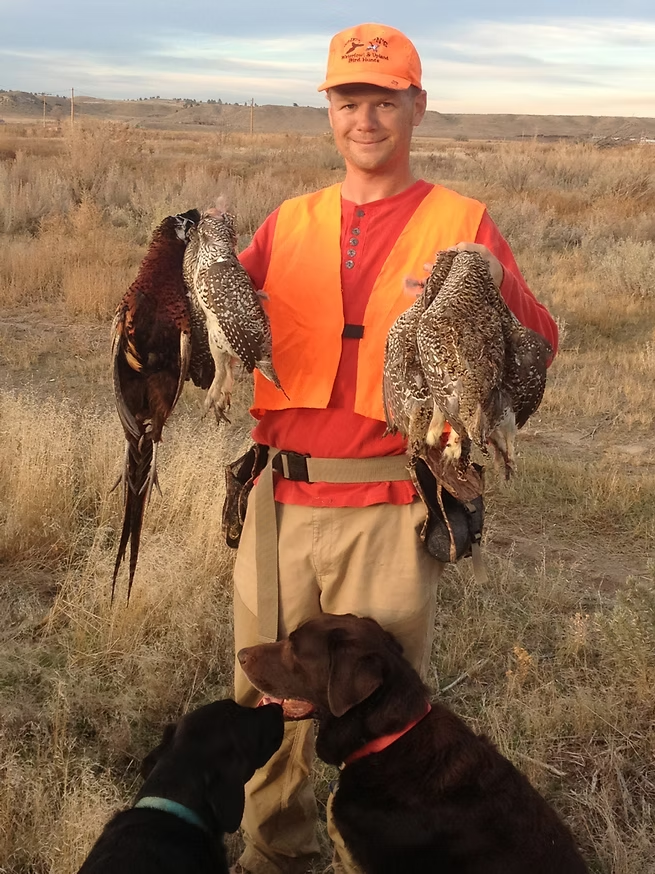
A happy Eastslope hunter and some of Stretch’s labs…

The weather for this trip was a string of identically hot days with clear skies and little wind. The days warmed quickly and by mid-day temperatures climbed into the high 90’s. It was dry heat, and certainly wet wading weather, though we only waded when we left the drift boat for bio breaks or just to get wet and cool off. The river temperature was likely in the low 60’s and very refreshing. This weather was the same we had experienced on the last trip, but Montana weather, even in late summer, can be horribly fickle. On that last trip, an Arctic cold front swept across the state and daytime highs plummeted from the 90’s to the low 40’s with rain and high wind. The surrounding mountains were capped with snow. I packed for this trip accordingly with waders, layers, a rain jacket, fingerless gloves and a warm hat though they never were needed. Be prepared for anything is wise counsel if fishing in Montana, particularly in late summer / early fall.

I’d be remiss in not mentioning the epicurean delights we feasted on during our stay. Because of my delayed arrival, I missed out on Stretch’s famous venison meatloaf. Meatloaf and gravy certainly qualify as wohlfühlessen, the German word for comfort food: better yet it makes for a great shore lunch sandwich. Alas, it was not to be for me on this trip.

The other meals were maple-glazed salmon on the grill, tasty BBQ chicken thighs, and for “the last supper”, grilled tri-tip beef, perfectly done. Each main course was accompanied by veggies and a starch. Prior to diving in, we were treated with outstanding salads freshly made by Jenna, Stretch’s culinary twin in the kitchen.

Stretch could do very well opening a side deli business. His sandwiches were primo and thick enough to choke a horse. I liked the touches of spicy relishes, mustard, and other condiments. All came with a salad, fruit, or coleslaw, chips, and cookies.

Damn good…

While the days were hot, the evenings were wonderfully cool. After a delicious meal, we’d gather on the lawn in comfortable chairs, smoke a cigar or drink a bourbon or beer, and look up to the star-studded night sky. Satellites streaked across the heavens along with the occasional shooting star. The quiet of the evening was deafening in its own way.

Cowboy boots and old wading boots adorned the fenceposts around the lodge.

As we closed our last day, we recounted the fishing and the size of the fish we caught, which is known amongst fly fishers to grow with time. But truly one of the high points was a comment Dan made. On the last day of our trip, he floated with Kent and asked guide Ian how he’d rate us as fly anglers. Ian’s response: A+. That meant more to me than the fishing itself.

I left that good place with sore forearms, a testament to the strength of the rainbows and browns that call the fertile Bighorn River home. We all departed Montana on our separate ways – Dan to southeastern Pennsylvania, Jeff and Kent to the Bay area of California, and me to Rochester, NY. And as with my previous two trips, the desire to return to that last good country was greater than ever. I know Dan, Jeff, and Kent would agree.

Side note, my trip home was flawless including early landings. Figures…

The Last Good Country – Part 2 of 2

Part 1 of this post covered the first four days of my Bighorn River fly fishing trip in mid-September of 2017. My brother-in-law and I fished those days on our own and did pretty well. With some initial successes under our belts, we couldn’t wait to spend some time with guides provided by Eastslope Outfitters.

The Old Hookers Guesthouse – a true fly fisher’s home away from home…

We checked in to the Old Hookers Guesthouse on Tuesday afternoon. We each had our own well-appointed bedroom and bathroom and the run of the house. The house is a very roomy split level – the basement floor had a convenient walk-in to a rod/wader room and utility room, perfect for stringing and storing your fly rod, donning your wading gear, and grabbing a few for the road from the “beer fridge”. Adjacent to the utility room were two of the five bedrooms in the house and a very comfy family room. The conveniences provided at the guesthouse impressed me – cleaning supplies of all types, a stack of cloth patches for line cleaning, and even spare waders and boots, if needed. Upstairs was another family room with fireplace, large kitchen, and dining room, as well as 3 more bedrooms with private baths.

Kent, Jeff’s co-worker and part of the original “10 year group”, had joined us on Sunday afternoon and fished with us on Monday. Kent arrived minus a prized fly rod, lost somewhere in the luggage on the flight to Billings. He was able to replace it with a brand new Sage, on sale at the Billings Cabelas. On Tuesday, the rest of the group trickled in – this included Dave, another of Jeff’s coworkers, and Jace and his daughter. The group represented a diverse mix of angling experience, from beginner to advanced angler. Fortunately, Jim and Joyce’s team of guides handled the mix of experience exceptionally well.

After everyone settled in, our cook prepared hors d’oeuvres and the beer and wine began to flow. This was a nightly ritual. Jeff and I had considered fishing that first evening, but we knew we’d be up early, so we decided to relax with the rest of the group, enjoy dinner, clean our lines, and get to bed early. It was customary for Jim and Joyce to stop by every evening around “happy hour” and check in with guests – a very nice touch. Besides getting to know their guests, they also used that time to make arrangements for the next day, including pairing anglers with guides.

Wednesday started early with coffee and a light breakfast and it wasn’t long before the guides pulled up, drift boats in tow. For my first day, Jeff encouraged me to fish with Jim, aka “Stretch”, while Jeff went with guide Jason and fellow angler Dave. Kent accompanied me for the day. Jace and his daughter went with Tyson. The two wanted to fish together and Tyson ended up being a perfect match for the mix of their fly fishing abilities.

Looking downriver at daybreak from Jim’s drift boat.

Jim does double-duty as Eastslope co-owner and guide. I was eager to fish with him: Jeff had nothing but raving reviews from previous years and claimed Jim could see fish where none seemed to exist. We launched that first morning from the 3-mile access and were soon drifting downriver while Jim talked about the plan for the morning.

Jim, left, rigs Kent up with a tandem trico dry fly set-up.

Jim talked about the trico hatch and the area of the river we’d fish. He rowed us downriver past cattle, grazing on the aquatic grass, and white pelicans getting set for their own fishing. After a 30 minute drift, we anchored along the river bank and got out to wade and sight fish. Jim set Kent and I up with tandem trico dry flies. He preferred to fish the dropper on 6X tippet. In his opinion, this removed doubt as to whether 5X was too much and putting the fish off. He also used desiccant on the flies pretty regularly so they would float well. He started me fishing and then walked with Kent upriver to get him situated.

Looking upriver on the Bighorn, with Kent fishing along the weed edges. Big pods of browns cruised upriver feeding in much the same way Jeff and I had observed on our first days on the river.

Eventually, Jim waded back down to me. He scanned the river for fish, his height and slightly stooped posture making him look like a big blue heron on the stalk. It wasn’t long before he sighted some browns slurping the steady downstream drift of trico spinners. He had me quietly move into position below them, then instructed me to put the flies just 6″ ahead of the fish at the tail of the pod. It was maddening seeing these fish feed with reckless abandon and at times almost bump my fly as they took the real thing. But both the odds and fishing Gods were in our favor: I watched my point fly disappear in a rise. “Set” was the word Jim loved to use to tell you when to set the hook on a take. And following his timing cue was a sure way to stick a brown.

Kent points to a mat of spent trico spinners pooled up in the river edge weeds.

I landed two nice browns under Jim’s guidance and though I was pleased as punch at the early success, he wasn’t satisfied with the number of shots I was getting. The pods were very sporadic in his opinion, popping up, going for a few minutes and then vanishing, reappearing elsewhere. He told me to continue to look for rising fish while he headed downriver to scout out another area. I managed another hook-up before he called me from the high riverbank to tell me to follow him downriver. He led me to a nice run below the broad tail-out where we’d previously fished. As we waded back upriver, I could see a large pod of fish – at least a dozen or two – gulping tricos along the weed edges. Jim had me work the lower fish first. The tandem rig did its job and we picked away at the pod, yielding many quality browns in the 16″ – 18″+ range. Partway through the morning, Jim had me change to a glass bead sunken spinner. This fly would sink and the lead trico emerger would act as an indicator when a trout picked up the sunken fly. It worked like a charm and I enjoyed a little dry fly indicator fishing.

Jim gives my new Orvis Helios 2 6 weight fly rod a test cast. He loved it…

The hatch began to dwindle as morning faded. The pods of voracious browns were gone except for an occasional and sporadic riser. Jim suggested we move on down the river.

We strung up our streamer rods and began casting. Jim pointed out one area where a fellow guide had a client hook into an 8 pound brown – the biggest of the year it turned out – that they fought quite a ways down the river. But this big fish went to a “hacker” – a client with little fly fishing skill. Jim’s guide friend had wished it on someone like Kent or I. Beginner’s luck is apparently alive and well even on the Bighorn River!

Kent and I didn’t move a fish with streamers. We stopped bankside for lunch and enjoyed a delicious venison meatloaf sandwich, salad, chips – a gourmet river meal if there ever was one (word was Jim makes the lunches). After stuffing ourselves, we pushed off and drifted downriver, ready to give nymphing a shot.

Jim anchored his boat tight to a high bank and along a fast and deep run. He rigged Kent and I up for nymphing with an interesting sliding weight, similar to a steelhead slinky but much smaller and made with lead putty. The nymph rig was “tractor trailer” under an indicator. Initially Jim had planned on using scud patterns, but Kent wanted to try the split case PMD that had performed so well for me when I was fishing on my own.

The split case PMD – a very effective Bighorn pattern…

I wondered whether the split case PMD would work wonders like it had originally for me. It didn’t take long before Kent was hooked up, validating the nymph’s effectiveness. I started hooking up as well, including a really nice rainbow lost at the net.

Kent, seen here, is nymphing the deep and fast run just downstream from where we anchored for lunch.

We ended the day fishing streamers to the takeout. Once again, the streamer bite was not there, but after a lot of fish in the net, it was nice to just cast away and enjoy a beautiful river. Jim proved to be a great guide – knowledgeable, wise in the ways of trout, patient, and fun. His forte is dry fly fishing, so if the hatches are on, he’s the guide you want for at least one day on the Bighorn.

An abandoned farmhouse on the Bighorn River…

Jeff had fished with Jason that first day. Relatively new to the Eastslope stable of guides, Jason was also knowledgeable, professional, and very capable. Jeff had good fishing with Jason and my second day of guided fishing would certainly validate that.

Jason picked us up bright and early on Thursday and discussed his plan of attack as we drove to the river. We would fish the same red bluff area that he’d taken Jeff to the previous morning. The hatch had been good there and the fish were willing. After that we’d fish streamers.

We reached the red bluffs and anchored up. Jason sent Jeff upriver to a spot that had some fish already working. He then climbed the steep bank with me in tow. We walked a trail downriver to a spot where the feeding was on. We descended below these fish and carefully waded up river towards them.

Jason rigged me up a little differently than Jim had. In Jason’s world of dry fly fishing the Bighorn, there was no need to use less than 5X tippet and in some cases he preferred 4X or even 3X. An interesting aspect of fishing with multiple guides is that one gets exposure to a variety of fly fishing methods, techniques, and tactics. Some differ significantly in their approach and views, but all of that is good for the angler who will listen.

Jason used his own flies and I could immediately tell he was a skilled fly tier. We fished a tandem rig of trico spinners and emergers. He had me work the pod from the tail but once again, the fish I hooked did not seem to spook the other risers. Jeff and I fished the hatch well, netting numerous good fish, losing some as well. Jason taught me to pick up the slack after every cast and to stay relatively tight to the fly to ensure a good and quick hook-set. It turned out to be a stellar morning.

As the morning hatch petered out, we set out downriver and switched over to streamer fishing.

Jeff hangs out in our drift boat while we break for a shoreside lunch.

Jason set me up with a sparkle minnow streamer (his own tie) as the lead fly.

The Sparkle Minnow had amazing movement and flash.

He then tied off the first streamer an 18″ section of tippet to which he tied a smaller streamer called, of all things, “the grinch”…

The Grinch – a streamer that might not steal Christmas but certainly will steal some trout…

Together, these two flies seemed like a perfect one-two punch; the sparkle minnow moving the fish and the grinch giving any hot trout a second chance if they missed the lead fly. Most fish were caught on the grinch but a few couldn’t resist the sparkle minnow streamer.

Jason was an excellent streamer guide, calling out where and how we should fish the river as we drifted. He’d say, “I want you to fish left here, give it a 5 second count”, “be ready to cast to the bank”, or “pick your flies up while we drift through this shallow riffle.” We fished the deep parts of the river using a sink-tip line, letting the flies sink up to a 10 second count depending on river depths. Jason also had us pounding the banks on a relatively short and fast cast. The visual of watching a nice brown peel off the bank to chase down a streamer made the repeated casting well worth it, even if they didn’t always take. Jason explained that when fishing the bank, you want to cast slightly behind the boat (upstream) so the fish has time to intercept the fly naturally and turn with the current rather than making the fish chase upstream. He also corrected my long strips, instructing me to work the fly in very very short staccato strips that better imitated baitfish movement. He explained the rationale very simply: how many baitfish can out-swim a big brown? By the end of our float, Jeff and I had done reasonably well but Jason felt the bite was off.

Thursday evening was windy with big gusts firing off the mountains and roaring across the river valley. Dust was blowing everywhere – a sure sign a front was coming through. Sure enough, as forecast, Friday dawned very cold and rainy – highs dropped from the 90’s to the low 40’s in just 2 days! Jim and Joyce’s advice to pack and be ready for almost any kind of weather was spot on.

Jason picked Jeff and I up early Friday morning at the lodge. As we drove out of Fort Smith he discussed his plan. He was concerned that the heavy overnight rains might begin to cloud up the water and that it would only get worse the farther downriver we fished, so rather than start at the 3 mile launch, he wanted to launch at the Yellowtail dam access, drift and strip streamers, then pull out at 3 mile and do another loop.

The after-dam access. This is the highest up the river you can launch on the Bighorn.

We were fine with the plan. Once we launched we were immediately hit head-on with a stiff cold wind that came right up the river. Though Jeff and I had foul weather gear on and had layered up under our waders and rain gear, the rain wet any exposed skin and the cold winds soon numbed fingers and faces. Neck gaiters and wool hats helped, as did the heavier work of casting and stripping tandem streamer rigs on sink tip lines.

Jeff cinches down while guide Jason re-ties a streamer. Jeff, from Northern Cal, was not so used to this type of fishing weather. For me, a north-easterner, it was not so bad. As the saying goes, “there’s no bad weather, just bad clothing“…

Despite the weather, I enjoyed the streamer fishing. Jason set me up once again with the sparkle minnow streamer as the lead fly and the grinch riding tail gun.

We picked up some fish, mainly browns in the deep pools, and then came to a river braid that Jason felt might hold some good fish. This braid was often overlooked apparently. We anchored at the end of the island and wade-fished the braid. I could see some fish periodically rising to something very small but nymphing this stretch was not moving any fish. After a while I asked Jason if I could try throwing a streamer. He was all for it so I pulled out my Helios2 6 weight and gave it a shot.

I walked up to the top of the braid and made casts across and up, letting my streamer sink and swing down. Occasionally I short-stripped across, and sometimes I did this on the swing. Just below the head of the braid was a large log-jam and perfect cover for trout. I worked my streamer through this area and had a solid splashy take.

The first of 6 trout from Jason’s river braid…

Repeated swings down the length of the braid and below where the water cut into a red clay bank brought many strikes – some short and some solid – for a total of 5 browns and 1 rainbow.

This rainbow smashed the sparkle minnow on the swing.

We continued our drift, throwing streamers, and hit the 3 mile pull-out at noon. We were pretty wet and cold and per Jason’s suggestion, drove back to the lodge to eat our lunch in the comfort of the dry and heated rod and wader room.

Jeff was done with fishing at that point. His rain jacket had been not much more than a wearable sieve to keep the big raindrops out; he was soaked through from the driving rain. I was pretty dry and wanted to give the fishing another round.

And so we went – just Jason and I – back out into the gray cold rainy afternoon. It was the same drill; casting, stripping, casting again, but oh how good it was to get out one more time. I caught some nice browns and lost a really good rainbow that I considered a final “thanks” offering to the river.

We all left the lodge the next day for home. I was the only one heading eastbound – the rest traveled westbound by plane or car. By 2 o’clock that afternoon, I was wing-borne and climbing high over Montana. From my window seat I got one last look at the khaki high desert landscape marked by little veins of green and gold. Then we were in the clouds and the last good country was gone. But, like Hemingway’s own northern Michigan woods, I now realized that one never really loses such a place.

Ernest Hemingway posing with a nice trout caught from the East Branch of the Fox River. This river was the river portrayed in his classic short story, “Big Two-Hearted River.” And it was the very definition of Hemingway’s “last good country.”

Credit: “Ernest Hemingway Collection. Photographs. John F. Kennedy Presidential Library and Museum, Boston”

My thoughts turned to fly fishing the Bighorn: the pods of rising browns, the trico hatches so thick they looked like rising smoke over the river, the sight of an indicator plunging down in fast water, the savage strike of a big trout intercepting a streamer on the swing, the company of friends, good food, a cigar and bourbon on the deck, the sun setting ablaze on high desert mountains, the good tired feeling after fishing hard all day, a worn-out casting arm, and the unfailing work of great guides. And I decided then, I’d return as long as I could to refresh my fly-fishing soul in my last good country.