One angler's journey, fly fishing through life

Tag: susquehanna river

More on Maddie – no better friend…

The following blog post was originally published on 12/5/2014, as an update on our adoption of Maddie. Her official “gotcha” day was February 23, 2013. We believe she was born in September 2013.

Those who follow this blog know a little about Maddie. I posted a piece on our adoption of her, or perhaps I should say her adoption of my family. She was a “return”. Previous owners had adopted her as a young puppy, but we believe may have found her too much to handle. So, she was lovingly taken back by her foster shelter, Every Dog’s Dream, in Greene, NY, and after we saw her photo, it was, as they say, love at first sight…

Most people know that Labs love the water. But Hound / Lab mixes like Maddie – well, I wasn’t so sure. Maddie is a Treeing Walker Coonhound and Labrador Retriever cross. She has the ears of a Lab, the head of a coonhound, the coat of a Lab and the tail and deeper chest of a coonhound.

The Treeing Walker Coonhound…

She’ll bay like a coonhound, even stand up to a tree if she’s chased a squirrel, yet she also has a deep bark that warns with authority. She’s goofy, playful, wicked fast, retrieves, and loves her toys…

A dog's gotta have toys...
A dog’s gotta have toys…

Maddie first met water not long after we adopted her in February of 2013. And beautiful Jones Park in Vestal was the site of our first forays in field and stream. Maddie loved the snow and the woods, but ice and water took some getting used to. The first time I crossed the brook there, she paced back and forth on the other side, whining aloud before finally being coaxed across the frozen surface of the brook. From there on though, she started liking water, and these days that little brook is a favorite of hers.

Beautiful Jones Park - this little brook was Maddie's intro to the wonderful world of woods and water...
Beautiful Jones Park – Maddie’s intro to the wonderful world of woods and water…

But that was generally shallow wading with the exception of a few plunge pools. It took most of the following summer before the Susquehanna River dropped low enough for easy wading and the perfect opportunity to introduce Maddie to real swimming and maybe even some river fishing. My first trial would be a “no pressure” jaunt to an area above the Campville fishing access where there was a lot of water with a gradual transition and areas shielded from river current. We took a ride there one Sunday summer afternoon. While I had my fly rod, the goal was to wet wade and fish casually, inviting Maddie to join the water and “fish” with me.

It’s never an issue getting Maddie to take a ride in the car. Open any door and she’s eager to climb in and take up position in the back seat. She’ll then plant both front feet on the center console and look forward, or roam across the back bench seat, poking her head out either open window, ears flapping in the wind. It’s a sight to see in a little Subaru Outback and reminds me that one day I really do need to get a pick-up truck…

Cruising and scoping out the countryside, Maddie style...
Cruising and scoping out the countryside, Maddie style…

So after we arrived at the large DEC access, I took a few minutes to rig up, and then set off up-river, through the woods. Maddie was all over the place in her usual land rover style; sniffing, marking, chasing chipmunks and squirrels – all good doggie stuff. We walked out to a large rocky bar on the river and there we did a little wading as I cast my line. Maddie never strays afar – possibly an attachment issue from her past. She was right by me the whole time. I waded into the river until she almost moon-walked the bottom – and that was good enough for our first adventure. I didn’t want to push it.

Maddie wades the Susquehanna shallows...
An intro – Maddie wades the Susquehanna shallows…

The following week we repeated the same exercise. Maddie was a lot friskier, chasing plovers, wading in where I fished while watching the fly line where it entered the water. We waded deeper this time but I wasn’t having much luck with the bass. Eventually we headed to a feeder creek with a very deep hole. I spied a bass in the hole and cast my olive soft hackle bugger across the pool. It was like ringing a dinner bell as 4 bass quickly emerged from the green depths. These fish had most likely been trapped in this hole all summer – the feeder creek tailed out to a slight trickle before entering the river – and as the saying goes, beggars can’t be choosers in a spot like that. The biggest of the bass struck my fly aggressively, not wanting to let such a meal get by, and a good tussle began. The fish darted towards the security of a downfall and root ball. I put the brakes on while hollering for Maddie. I lipped the bass, removed the hook, gave Maddie a chance to say hello, and then released the bass. Maddie literally dove right into the hole in pursuit and soon experienced water without bottom. She came dog-paddling back, no worse for wear, and a certified swimmer!

Scoping out the faster water....
Surveying the faster water and making Dad a little nervous from afar…

I was thrilled, but never doubted she could do it. So we returned to the river the following week with a plan to explore a little more. I wondered, would she travel down to the honey hole – the one where the bass could be big – the one I loved to fish?

We got to the access and this time took a wooded path downriver. The path paralleled the river for a bit and then veered off along a river braid. As we hiked, Maddie would dash down to the river braid and then charge back up to find me, flying up 6 foot banks like they were nothing. Soon we came out where the river braid re-entered the river at a beautiful bay that I love to fish…

This is sweet water for fly fishing and fishing this spot gave Maddie the opportunity to explore the river-side and take a swim.

Loving the river...
Loving the river…

Soon after arriving, I cast and swung my olive soft hackle bugger through a chute of water from the river braid and that proved to be a little too much for one nice bass. The fish took the fly solidly and went airborne with the hook-set. Maddie rushed in deep where the bass zigged and zagged, trying to intercept it. At one point it darted between her legs!

A nice smallmouth landed with aid of a water dog - note the paw in the upper left...
A nice smallmouth landed with aid of a water dog – note the paw in the upper left…

Soon enough I had the bass lipped, then removed the fly and put it down for a picture – Maddie’s paw included. Maddie began pawing the bass as I put my camera away and that was enough to send it off in a big swag of its tail.

Soon after hook removal, an errant "pat on the back" sent this bass fleeing...
Soon after hook removal, an errant “pat on the back” sent this bass fleeing…

But as the saying goes, all good things must end. So it was for our river sojourns. Not long after enjoying these visits to the Susquehanna, the rains came, the river rose, and then the cold swept in. Summer faded to fall and then to “see you next year”. No matter, it was great to have a fishing buddy on the river with me…

Relaxing on the deck with a glass of wine after a good day on the river...
Relaxing on the deck with a glass of wine after a good day on the river…

And borrowing a prophecy picture from my original post on Maddie, I’d say she’s turned out to be quite a friend for a fly fisher…

Oh the places we'll go...
Oh the places we’ll go…

The Cobbler

“Remember, cobbler, to keep to your leather.”

Michel de Montaigne, French philosopher, on staying true to one’s craft.


By all accounts, it had been a great year of fishing. My logbook listed just shy of 50 trips the previous year, excluding many half hour jaunts on my backyard pond to unwind after work. So, during my early spring gear tune-up and overhaul, it didn’t surprise me that my boots were in pretty sad shape.

I contemplated, dare I say, putting them out to pasture. After all, I’d owned them since I started fly fishing some 10 years earlier. I bought them mainly for bass fishing in the rivers – a relatively inexpensive but classic design – and Hodgeman’s no less – still made in America back then. They’d served their master well, and the mantra of this throw-away society hummed away in my head as I looked them over. Those glossy catalogs of the big brand fly fishing purveyors sell a compelling story – faster, lighter, better, tougher…

Oh, the places they took me…

The fly rod may be the heart and soul of a fly fisherman, but its his boots – the workhorse – that get him where he needs to be. They take the most abuse – the lion’s share of wear and tear of all a fly fisher carries. They are rarely in the picture of the beaming fisherman holding up the bounty of the day’s trip. And at the end of the day the weary fisherman unceremoniously sheds them, and stows them out of the light, beneath his waders, the Rodney Dangerfield’s of the angler’s gear – not getting a whole lot of respect. But like the weathered hands of a farmer, a well-used pair of boots has a story. To anyone who sees them, they speak experience astream. And they get better with age – fit better and somehow feel better. So, for these reasons, and the outright economic prudishness these times demand, I reconsidered the death sentence I was about to hand down…

There’s an old shoe repair store on the mostly bypassed main street of my town. The stores that surround it are largely what you’d call mom and pop businesses. Some storefronts are shuttered looking for new owners, the victims of the big box retailers that now line the parkway to the east. This little place sits among them – a classic sign marking its existence. It is busier than one may think.

You won’t find Gucci here, but he could repair them…

So, I went there one day on lunch break, boots in one hand, new Hodgeman’s felts in the other. Inside, the place breathed leather, shoe polish, and glue. Behind the counter was a doorway, a window into the lonely world of the cobbler. In the back of the shop was a long workbench, shoe anvils, all types of tools – awls, picks, and mallets – and racks of laces, shoemakers stitching, and leather. To the left of the counter were the fruits of true craftsmanship – neatly set in racks, tags hanging with names of owners. Every shoe, boot, belt, and handbag was polished. I began to feel good.

Inside that door waits a true cobbler…

The cobbler soon emerged from the back, clad in a heavy leather apron, workshirt, and brimmed hat. His whole appearance, including the neatly trimmed beard covering his jaw, seemed Amish, though I couldn’t be sure, and his hands testified to his work ethic – rough, calloused, and black with polish. His demeanor was pleasant. He studied my boots, turning them in his big hands – pulling the tongue back, examining the sides.

That my boots needed to be re-soled was apparent. The felt was worn thin and, in some places, de-laminated from the boot bottoms. But it’s what I didn’t tell him that he seemed to focus on. “I can re-glue the inside sole”, he said. He continued examining my boots, noting how the stitching on the outer sides was frayed and, in some cases, parted. “I’ll re-stitch these here”, he added. We settled the particulars – I could pick them up in a week. He marked a tag with my name and phone number and set them in a rack of accumulating work. He asked where I fished. The Susquehanna he was not too familiar with – he had canoed a few local lakes, but not the rivers of the Southern Tier. So, for the next half hour I told him about the fishing – the big smallmouth bass, walleyes, channel cats, carp, and musky that could be caught, and then about the wildlife that could be seen – mergansers that flew like sea-skimming missiles up the river and the osprey that dove straight into the river like a rock dropped from the clouds and the eagles that cast big shadows where they flew, and the great blue herons that at a distance in the early morning mist looked like hunched old fisherman working a pool. All these things I had seen because of my boots.

A week later I returned – a sunny spring day full of promise. I picked up my boots, newly clad with bright white felts, neater in appearance, restitched, all put together, and ready for work. The fee was so nominal I can’t recall it now, but for the memories they’d bring me, I should have paid a hell of a lot more.

Coming to a river near you, the Flathead…

Mama always said, life is like a box of chocolates. You never know what you’re going to get.

Forrest Gump

While perusing Facebook one morning, I came across a picture that rather startled me in both a good and bad way. I’m a Facebook friend of long-time fishing guide, Lance Dunham, and in my feed was a report from a recent outing he made with clients. Typical of Lance were pictures of some very nice smallmouth bass, but there is always a smattering of other species mixed in. This is one reason I have always enjoyed fishing the Susquehanna and its tributaries: the diversity of species the river offers up. On any given day, one can tie into smallmouth bass, fallfish, northern pike, carp, channel catfish, walleye, rock bass, and musky. And Lance’s post proved you can now add another species: the flathead catfish. But whether this is a good or bad species to add to the list is up for speculation over the longer term.

A client of Lance Dunham, fishing guide, shows a flathead catfish caught in the Susquehanna, south of Towanda PA

The flathead catfish has been grabbing news headlines over the years in towns and cities around the lower Susquehanna River. In 2020, a 56 lb. fish was caught, establishing a Pennsylvania state record. 3 years later, the state record was broken again by a 66 lb. flathead caught in the Susquehanna near Conestoga, PA, roughly 30 miles southeast of Harrisburg.

The record-setting angler was fishing with a friend in a very deep channel of the river known as Lake Aldred. He had baited a live rainbow trout onto a large circle hook with a 1.5-ounce sinker. The pair had four lines in the water at once and it wasn’t long before they had 3 hook-ups – landing a 30 pounder, a 45 pounder, and finally the new state record fish.

The current Pennsylvania state record flathead catfish

The huge flathead catfish officially weighed 66 pounds and 6 ounces, exceeding the previous state record by more than 10 pounds and measured 50.25 inches long with a girth of 35 inches. To show just how large flatheads can grow, Pennsylvania’s record is just half the world record, set by a 123 lb. fish caught out of a reservoir in Kansas!

The fish was released alive by the Pennsylvania game warden certifying the record. I found it odd that the angler was using a gamefish for bait, but Pennsylvania allows the use of gamefish for bait as long as they are fished whole. More interesting was the fact that such a fish with a record of being “invasive” was released alive.

Turns out the topic of “invasive” is in itself confusing. The flathead catfish (Pylodictis olivaris) is native to the Mississippi River basin, which includes parts of western Pennsylvania—specifically the Ohio River drainage. So, while it’s native to the greater state of Pennsylvania, it’s only truly native to that western sliver of the state, and certainly not native to the Susquehanna River basin, where it was first detected in 1991. It has since spread rapidly.

Flathead catfish are apex predators, sitting at the top of the food chain. Once introduced to the Susquehanna River, they’ve begun reshaping the ecosystem in dramatic ways that include predation of native species such as smallmouth bass, channel catfish, baitfish, and even crayfish. Their presence also forces other species to change their diets and habitats to avoid competition or predation. Channel catfish, for example, feed lower on the food chain in areas where flatheads are present. And because of this broad dietary overlap, ecological balance can be affected. Smallmouth bass, channel catfish, and carp all feed on crayfish, making the flathead just one more “consumer” of that resource.

Pennsylvania is taking steps to manage this invasive species. There is no creel limit for flatheads, for example, and catfish is a good eating fish. While there is a creel limit for channel cats in Pennsylvania – 50 per day – New York has no creel limit. One has to wonder if at some point these limits will be adjusted due to the flathead’s predilection for eating anything that swims.

In addition to the absence of a creel limit, there is also no mandate that flatheads be killed, such as is the case for snakeheads in Pennsylvania, which must be both killed and reported. In waters like the Delaware and Susquehanna River basins, anglers are only encouraged not to release Flatheads, regardless of size.

The concern of the flathead’s opportunistic predation and its potential to decimate native and recreational fisheries has led a team of researchers from Penn State, the U.S. Geological Survey (USGS), and the Pennsylvania Fish and Boat Commission to assess how flatheads are affecting the food web and energy flow in the Susquehanna River in Pennsylvania.

Their research found that flatheads had the highest trophic position – the level an organism occupies in a food web, based on its feeding relationships – even higher than resident top predators such as smallmouth bass and channel catfish. Channel catfish had a lower trophic position in areas populated with flathead catfish. This means they had to eat lower in the food chain, likely because they are being outcompeted by flatheads or avoiding them. In areas with flathead catfish, they also found all species showed broader and overlapping diets.

The research suggests that resident species are changing what they eat to avoid competing with or being eaten by the invader. The research also supports the ‘trophic disruption hypothesis,’ that says when a new predator enters an ecosystem, it forces existing species to alter their behavior, diets and roles in the food web. This can destabilize ecosystems over time. The study highlights how an invasive species can do more than just reduce native populations – it can reshape entire food webs and change how energy moves through ecosystems.

In addition to evaluating trophic position, the researchers also analyzed the isotopic niche occupied by the fish species – the range of carbon and nitrogen markers found within the tissues of an organism, reflecting its diet and habitat, providing insights into its ecological role.

To reach their conclusions, the researchers employed stable isotope analysis, a widely used tool that can explain patterns within a food web, highlighting links between trophic positions, as well as the breadth and overlap of trophic niches.

When fish eat, their bodies incorporate the isotopic signature of their food. By sampling their tissues, scientists can measure nitrogen isotopes and determine their diet, carbon isotopes to determine habitat use, and compare isotopic signatures across regions to deduce fish migration or habitat shifts. For this study, channel catfish, smallmouth bass, minnows and crayfish were selected as focal species because a previous diet analysis conducted in collaboration with Penn State, USGS, and Pennsylvania Fish and Boat Commission researchers within the Susquehanna River, showed that these species are important prey for flathead catfish.

“Flatheads grow fast in this river system, attain large body sizes and can eat a variety of prey,” said study author Olivia Hodgson, a master’s degree student at Penn State University. “Because adult flatheads have few natural predators, flathead catfish can exert strong control over the ecosystem.”

But invasives are nothing new. Zebra mussels, carp, Didymo, hydrilla, rusty crayfish, gobies – our waters have weathered all manner of invasives with different results. The St. Lawrence is one system hugely impacted by zebra mussels. I can recall fishing there in the 90’s when pike were plentiful in vast aquatic weed beds. Zebra mussels changed all of that – the water is now crystal clear, favoring smallmouth bass and diminishing northern pike populations.

I had the opportunity to discuss the invasion of the flathead during an outing with guide local guide Jimmy Kirtland of Row Jimmy’s guide service. Kirtland guides on the Susquehanna and other local rivers for smallmouth bass, channel catfish, and musky. His response to whether flatheads will truly change the fishing was muted, saying there is often a lot of anxiety to the news of invasives, but things tend to work themselves out in the long run and not become the environmental disasters that were originally feared.

The primary method of catching flathead on rod and reel is using live or cut bait. Flatheads are very different from channel catfish. They have relatively small eyes whereas channel catfish have large eyes.

The beady eyes of a flathead…

And flatheads, especially the large ones, prefer live bait, and less so dead or even the stinky kinds of baits used for channel catfish. They prefer to feed at night but can be caught during the day around submerged structure, especially wood snags. The larger fish tend to be loners and will be very aggressive towards any fish, including their own.

But can they be caught on a lure or better yet, the fly? The fact that Lance Dunham’s clients are catching them is evidence of their taking a lure. But the fly? The answer is yes and I didn’t have to look far on the internet to find that answer. Flylords Mag featured an account of an outing by two anglers in eastern North Carolina. While sight fishing for longnose gar on a local river in low, clearwater conditions, these anglers stumbled upon a group of flatheads…

My buddy was in front of me and reached the pool we had in mind first, and yelled that there were 4 or 5 GIANT CATFISH. I didn’t realize how big he meant until I caught up with him and looked where he was pointing. These absolute giants were congregated and slowly cruising around at the top of the hole, and we both started freaking out. I had broken my 9wt earlier in the week and was using my 8wt with a slightly sinking tip. I tied on an EP brush fiber & deer hair gamechanger fly I tied the night before. I cast to the closest fish and just hovered it in front of its face, with a few short and abrupt strips. I immediately froze for a moment as I saw its mouth open and engulf the fly. The fish kind of turned in confusion for a slight second and shot downstream as it realized it was hooked.

Fly angler Andy Howard cradling a river monster…

I held on to my rod and barreled downstream after it, tearing my legs up in the process. I knew this was the biggest catfish I’d ever hooked and my mind was just racing. The pools are closely connected and are very deep so I had to plan on where to step accordingly. This didn’t really work out as I fell many times just to keep up with this fish, but I didn’t care. It seriously felt like I had hooked into a truck, and I was the one being controlled. I get crap constantly from my buddy’s because I use straight 35-pound mono as my short leader (for toothy gar and bowfin) but I was glad I didn’t have anything less than it on. I truly did not think I was going to land this fish because for every inch I got on him, he took back two feet or more. At the bottom of the third or fourth massive pool, the catfish realized it couldn’t go any further downstream as the river started to shallow up, and decided it was heading back upstream. I obliged. After a fight close to 45 minutes, and when fish was finally growing tired I managed to guide it into one of the open rock crevice areas where I felt I could most safely unhook it and admire it.

To pursue these fish on the fly, think very large flies with lots of movement, fished deep in snaggy structure by day and in shallower areas adjacent to holding water at night. Gear would need to be of the salty type – a 9 – 11 weight fly rod, big reels spooled with lots of backing and depending on the depth fished, intermediate to sinking fly line and a heavy, 30 pound-plus, short leader.

It’s likely that guide Lance Dunham’s future fishing reports will include more flatheads being caught, but will the smallmouth bass make less of an appearance going forward? As a long-term fly angler of the Susquehanna and its smaller tributary rivers, I’m never disappointed when I run into channel catfish. While I’d hate to see the balance that exists now shift largely in favor of “the invader”, the thought of hooking up with one of these river monsters on the fly sings a siren’s song…

My tribute – On the river with Michael

In our family, there was no clear line between religion and fly fishing. We lived at the junction of great trout rivers in western Montana, and our father was a Presbyterian minister and a fly fisherman who tied his own flies and taught others. He told us about Christ’s disciples being fishermen, and we were left to assume, as my brother and I did, that all first-class fishermen on the Sea of Galilee were fly fishermen and that John, the favorite, was a dry-fly fisherman.

Norman Maclean

Every once in a while, fly fishing connects with the universe in strange but meaningful ways. For me, the term “universe” is another way of referring to my faith. I am Catholic and as such, believe in heaven. Certainly not all fly fishermen have the same view, but I think, religious or not, we all tend to believe in some form of the hereafter. Such was what I read from comments on Facebook when I was shocked to learn that Ithaca-based fly fisher, Michael Lenetsky, had passed unexpectedly on September 19.

Josh said it best – Michael collected people, and it was overwhelming to see all the people that he befriended come together. Michael cast a wide, diverse net and it was on display today.

This sucks. I’m finding we are all like the Mayflies, here but for a brief, fleeting moment. Tight lines, brother. See you on the water my friend.

Unforgettable. Until we meet again my friend, but for now he’s gone fishing.

I knew Michael as an excellent angler with a great sense of humor. I didn’t know him well enough to call him a friend, but he was certainly a good acquaintance. If I lived in the Ithaca area, I’m sure I’d bump into him enough on the local waters to develop a deep friendship. I’d listened to a few of his informative presentations on fly fishing the Cayuga Lake tribs and had lunch with him once when I worked in Ithaca.

I was down in Vestal for a charity event with family on September 20th, unaware of Mike’s passing and remained in Vestal, “off grid” for the next few days, having decided to get in some early fall fly fishing on my beloved warmwater rivers. Each night before sleep leading up to my trip, I rehearsed the places I’d fish with anticipation that there would be some big smallmouth in the mix. Instead, the fishing was good in a different way, including a 15″ black crappie, a real unicorn in a river, and a very hot and repeatable channel catfish bite.

I fished the Tioughnioga on Sunday, September 21st, in a spot where there were always big carp mudding and channel catfish in a backwater hole, but caught neither, instead getting into a bunch of rat bass and fallfish, a respectable walleye and the aforementioned slab of a crappie.

Certainly a river unicorn…

On Monday, September 22nd, I floated the Susquehanna below the Apalachin access on the hunt for the large smallmouth that can be caught there. I landed a dandy 19″ bass almost immediately and a big channel catfish a while later but then decided to venture further downriver where I knew of some other bassy lairs. After a few hours of nothing, I returned to the first area I had fished that morning and working several deep runs, got into 2 more channel cats and lost a third.

19″ of river bronze…

I waded the river on my final morning and returned to the area where the catfish bite had been so good, hoping to prove that the bite was not a fluke. And it wasn’t. As was the case the day before, I fished several deep runs, working a size 2 wooly bugger on the swing, interspersed with staccato strips. The takes were hard, shy of ripping the rod out of my hand. The fight of a channel cat is a wonderful mix of a bulldogging smallmouth, and the powerful drag-pulling runs of a carp. I landed 3 channel cats and lost a fourth, all the while thinking of Michael.

The fish Michael was meant to catch…

I’d posted pictures of channel catfish in the past and Michael had commented that he wanted to learn how to fish for them. We had discussed this a few times on Facebook messenger but, regrettably, never made it happen. Now, as I fished, I felt a deep need to get in touch with him when I got home if only to let him know he needed to get down to the river as soon as possible to get in on the bite.

Returning home that afternoon, I got on Facebook to message Michael, and there it was in a post by Eric Mastroberti – the news of Michael’s passing. It hit me hard. It left me reeling with questions. I chatted with Eric Mastroberti on messenger about it, mentioning how strong my desire was to reach out to Michael after such good luck with the channel cats. Later, I’d find a Facebook post by another fellow angler, Kirk Klingensmith:

Sharing photos from the river in honor of my friend Michael Lenetsky, who passed away 9/19/25. I still have not processed his passing – but in retrospect, I am overwhelmed how the last week has connected to Michael, some incredible fish (Was Michael channeling??), and the circle of fly fishing community friends. On the day of Michael’s passing, I was floating the same section of river that Michael & Tony Ingraffea floated a few years back. It was Tony that gave us the news that day when we got off the water.

I’m not sure what Michael thought of heaven or where we go when our time on this good earth ends, but fishing that weekend in a river as old as time, feeling the surge of life on the end of my line, thinking of Michael only to come home and hear he had left us, well, that’s just too much to be nothing but a coincidence.

Rest in peace, Michael.

A fly fisherman’s Thanksgiving – there’s not enough lifetime…

A recent post on a popular fly fishing website reminded of something I’m very thankful for this Thanksgiving: our endless opportunity as fly fishermen. While it is easier and easier these days to decry what seems like our nation’s going to hell in a hand basket, I can and will, with drumstick in hand, be thankful for the fact that there’s too much water to cover.

Consider this quote from Andy Mill’s well-written interview post about tarpon fly fishing guide Steve Huff:

“It makes me crazy when people say, “Oh. I know the whole Islamorada area.” You know what? Nobody knows this stuff. I mean they do not fully know it. You could never know it. There is not enough lifetime to really know it all, especially here in the Everglades. There is not enough lifetime“.

There’s not enough lifetime. We fly fishers should always be thankful for that.

I am thankful for the fact that I can fish an entire day on the Susquehanna, the Tioughnioga, the Chenango, and so many more rivers, and never see another fisherman.

The Susquehanna River

I am thankful that I can rise early and spend time over a steaming cup of black coffee, and still not know where to fish, so vast are the choices. I am thankful for the spring days, when mayflowers abound…

West Branch of the Delaware in Spring

and I can’t quite decide whether I should fish for pre-spawn smallmouth, or the wild rainbows and browns of the Delaware.

A West Branch Delaware River brown…

I am thankful that I can fish coldwater and warmwater, moving water and stillwater, freshwater and saltwater, in the same weekend.

Party boat fishing at night for blues off New Jersey…

And I am thankful for the spawn, and the great fish that are driven up small creeks to pass on their noble heritage.

A landlocked salmon caught from Fall Creek…

I am thankful for the endless drive of Mother Nature – for nature’s drive to procreate, for the force that fishes have to feed, and for the excitement these forces can cause. I am thankful for everything that depends on water – eagles, heron, wood ducks, mergansers, deer, otter, beaver and bear. I am thankful that they too are drawn to water.

At the end of an early morning on the river, with the fog lifting, and the day just starting for most in this world, I can’t stop pinching myself for the very fact that there’s not enough lifetime.

Happy Thanksgiving…

Home Water

Father, you are not yet past the summer of life; your limbs are young. Go to the highest hill, and look around you. All that you see, from the rising to the setting sun, from the head-waters of the great spring, to where the ‘crooked river’ is hid by the hills, is his. He has Delaware blood, and his right is strong.

James Fennimore Cooper, Pioneers

It’s been over ten years since I first took a trip out west to meet my brother-in-law, Jeff, and fly fish the Bighorn River. This was my first trip to Montana and the Bighorn lived up to its reputation as a fly fishing mecca then, as it did on a 2017 trip, recounted here. Jeff and I spent three days with a guide on that first trip, nymphing the deep pools and fast riffles, and we each caught over 30 trout per day. But the highlight of that first trip for me was not so much the fishing, but discovering the meaning of ‘place’ in one’s life.

Towards the end of our trip, we drove into the mountains overlooking the Bighorn River Valley. The road zigged and zagged its way up into the highlands. The grass on the hills waved softly in the light breeze and in the draws we saw cattle and mule deer. When we reached the heights we found a road-side monument surrounded by a rough-hewn rail fence. Within the fence was a tall stone obelisk monument, each broad side oriented to a cardinal point of the compass with its own tribute to the Crow Indians, the first human inhabitants of the Bighorn Mountains. Below, spread before us was the river valley, carpeted in the gold of wheat, and cleaved by the Bighorn River, a blue-green ribbon fringed in cottonwood. We stood in silence and read the plaques, one of which resonated in my soul…

“The Crow country is a good country. The Great Spirit has put it exactly in the right place; while you are in it you fare well; whenever you go out of it, whichever way you travel, you fare worse. It has snowy mountains and sunny plains and all kinds of good things for every season. When the summer heats scorch the prairies, you can draw up under the mountains, where the air is sweet and cool, the grass fresh, and the bright streams come tumbling out of the snow banks. There you can count the elk, the deer, and the antelope when their skins are fit for dressing; there you will find plenty of bears and mountain sheep.”

The words reminded me of my own sense of place and affirmed my belief that just as all people need a home, all fishermen should have home water, a place to learn the cycles of life and to fall in tune with the season’s rhythms so that one day it may be completely understood and in that knowing, truly cherished and revered, a place where you are as whole as you will ever be.

For me, the Susquehanna River Valley and its 3 great rivers – the Tioughnioga, the Chenango, and the Susquehanna, which my house overlooks, are my home waters. It is there that I go most – where I am most confident and connected – and it is there that I feel blessed with fly rod in hand.

Susquehanna smallmouth…

A trip early one summer to the beautiful Thousand Islands region of the St Lawrence River reinforced this belief in ‘home water’. I drove north on a Friday to visit my high school buddy, Bill, and his family. I fished there for two and a half days and, quite honestly, was humbled. After all, Bill and his father had fished these waters for over 40 years. Die-hard spin fishermen, they quickly proved their worth. Bill’s father fished Canadian waters with his son-in-law and grandson, while Bill and I focused on the New York side of the river. From a fly fishing perspective, I had come pretty well equipped for the depths we’d fish. I brought 7 and 8 weight rods and a variety of lines, including a full sink shooting head. It took a while to dial in, but by my 2nd day on the river, I had found the combination of line weight for the various water types. Yet in no way was I high hook on the trip. I quickly realized it’s not easy fishing in another angler’s home waters…

Bill with a beautiful St Lawrence smallmouth…

Unlike the wading I am used to, we fished from a boat. Bill and I found fish in the drop-offs surrounding the abundant shoals of the river. As I explained to Bill, my greatest satisfaction in fly fishing has always been to figure out the bite – the great fishing puzzle; where the fish are, and what they’re feeding on. To do that is the pinnacle of fishing success in my opinion.

One of the many thousands of islands the St Lawrence is known for. Note the stone duck blind…

I left the St Lawrence happy, having spent quality time on and off the water with great friends. And I returned even more reverent towards my own home waters. Like so many places in our great United States, the great Susquehanna rivershed, once called home to thousands of Native American Indians, calls me too. And while the exact meaning of “Susquehanna” remains unknown to this day, the river passes on its own timelessness in a soft steady melodic flow.

Now, years later, I still fish the ‘crooked river’ and its tributaries. Bill’s father is gone and his old place, a tidy trailer in Kring State Park, sits most of summer alone, save a few weeks here and there when Bill and his family go there. In the spring I wait the watershed snowmelt, selfishly hoping for a dry beginning so I can fish the smallmouth pre-spawn, a time when the bass are staging to spawn and feeding voraciously ahead of weeks where procreation takes center stage in their cycle of life. In summer I wade wet, focusing on either end of the day. Summer is when one can find the bass off the river grass, busting bait, and in the riffles during the hot and bright days. Come Indian summer, and fall, the bass are in prime condition, feeding in preparation for the long winter ahead. Then I fish from my kayak, throwing streamers to shaded structure. The bass are often as fat as footballs.

Susquehanna smallie...

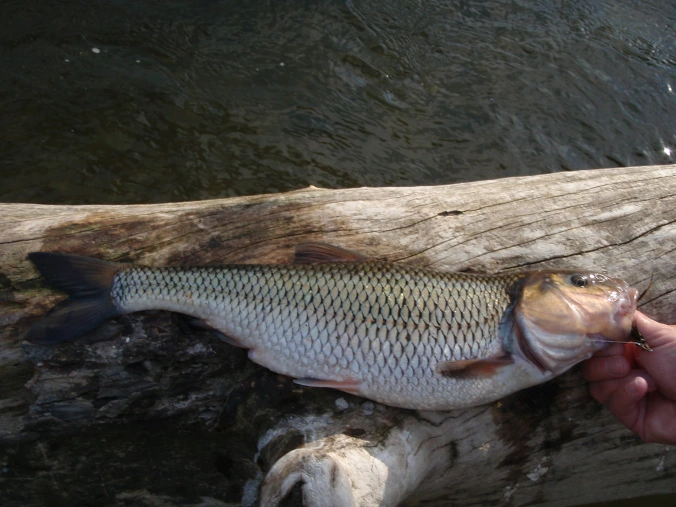
With the bass comes the by-catch, and they are always welcome. Fallfish will often strike a streamer or nymph and fight several times their size. These fish are famous for their nest-building prowess. They spawn in the spring and the males take on a red to magenta hue to their heads, along with “horns” that look like large pimples.

OLYMPUS DIGITAL CAMERA

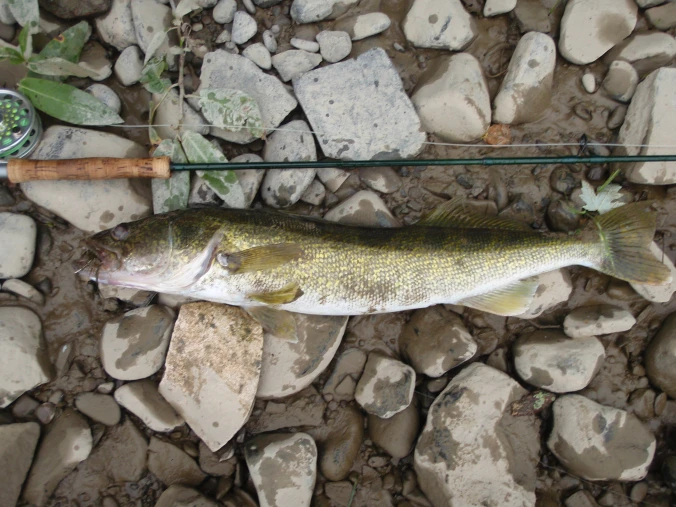
Then there are walleye, some of which can be quite large. They ply the pools and deep runs, jaws bristling with canines, ever hungry.

OLYMPUS DIGITAL CAMERA

Carp are always in the mix, too. Even when not fishing for them deliberately, an occasional bruiser will strike a streamer or nymph. They are the bear of fish – dominant omnivores of the river environment.

Channel catfish are another species that will whack a deeply fished streamer with authority. They are the biggest-eyed of the catfish, sight as well as scent-driven, and will fight doggedly when taken on the fly.

It ain't no bass, but it'll do...

At the apex of the river’s food chain are the northern pike, tiger musky, and musky. These fish, in particular the musky, can attain size of 50″ or more. Twice in my fly fishing history on the river, I’ve “hooked” them, but have never landed them. Both times these fish took the 12″ smallmouth bass I had hooked on the fly and both times they surprised me at how hard they fought while not being hooked. They hung on to their prey for 20 minutes each – one of them towing my kayak up river. The fight normally ended close to me with savage headshakes that told me, “you’re really pissing me off now.” As hard as I tried, I never landed either, but they made river memories that keep me coming back.

Musky bait on the fly…

And always surrounding the fishing, there is the river. I have waded her warm waters in the company of so much wildlife: Canada goose, mergansers, snowy egrets, green herons, blue herons, kingfishers, swallows, red-tailed hawks, bald eagles, ospreys, whitetail deer, mink, porcupine, beaver, muskrat, raccoons and sometimes too, black bear.

Once I watched a bald eagle chase an osprey, fish in its talons, flying upriver and into a tree line. The pair looked like a big P-47 Thunderbolt chasing down a Spitfire. Many times have I witnessed the long-eyed scan of the osprey and then it’s mid-air hover and perilous dive. Many times have I stood looking skyward as swallows darted about feasting on a hatch of mayflies, picking off each tiny fly with amazing precision, diving, swooping, careening, hovering, feasting on the emergence of life from the river.

In the late summer, there is nothing like the white fly hatch, the duns racing upriver with their nymphal shucks trailing, like heavy snow blowing horizontally in a blizzard.

And then there’s the fall, the glorious debut, when the silver maples lining the river cloak its banks in gold, the fitting dress for such an old and majestic river – the king of rivers east of the Mississippi. There will be October caddis then – those big orangey fluttering bugs that on occasion will bring a bass to rise. The shiners and dace will be big and the bass, walleye, and channel cats will key in on them, the pike and musky preferring the young of the year fallfish, quillbacks, and bass. They feel the change coming as mother nature pushes them to feed up before the starvation period begins. And feed they do, creating a bounty for the fly fisher…

Those late fall afternoons can take on an Indian summer – the crickets and cicada still in the trees, the sun warming them before the rush of wind and charge of cold. I’ll take a rest sometimes at the end of a day fishing, sitting river-side, soaking-in the end of bounty, feeling then what the Crow perhaps felt about their land – home where the river is plenty enough to be happy…

This stretch of rocky shoreline featured just the kind of habitat smallmouth bass love, along with some bigger toothy predators...

The days that keep you young…

We had a remarkable day of catching, and he turned to me as he winched the boat onto the trailer. He had a giant cigar clamped between his teeth, and a large grin. “Those are the kind of days that keep you young, son,” he said, and then he cranked the winch handle like a man half his age.
Fish Pimping
Callan Wink

With the job interview over, I walked out into the warm day, loosened my tie, removed my sport coat and got into my car for the drive home.  The route I travelled brought back memories: some 15 years ago I made this daily trip – a long drive up Route 12, speeding north to work and then south back home, the Chenango River a constant companion.

Fall was making its mark onto the year and the once verdant hills around me were proof of it, standing tall cloaked in hues of gold, amber, and crimson. Like me, they were turning with the passing of time. From the youth of spring and the strength of summer, autumn perched at winter’s door in one last stand of grandeur.

Once home, I wolfed down a hastily-made sandwich, chugged a beer, and broke out my fly fishing gear. I cleaned lines, checked leaders, gathered fly boxes, and was out the door in a rush of new-found urgency. While the day was hot, mid-summer like, the forecast forebode it’s staying power. The next days would suffer a cold front with a drastic drop in daily highs and with heavy rain as well.

The Susquehanna was still placid, barely meandering along at late summer flows. The heat and humidity of the day were in stark contrast to the water temperature, however. Once I was geared up, I waded in wet and felt a cool shock pass up my legs. Just weeks ago, the river was as warm as bath water but now it was well into the fall cool-down.

I headed downriver to a favorite place. Despite the calm in the air, the cricket’s song in the surrounding woods, the warm breeze blowing up-river in gentle puffs, I could sense impending change. Fall meant the feeding up and I was sure the cool water temps were sending that signal to the smallmouth bass. The barometer had been falling, another factor in my favor. Maybe, I thought, after so-so fishing earlier in the week, I’d get into them good again.

My first stop was not quite up to my expectations. I cast a streamer across and down a run and picked up a small bass, then lost another of some size that left a boil in the river and an empty fly to my side. Nymphing up the run did me no better. It was 4 pm and the sun was nestling into the river tree-line to my back, casting shadows on the south side of the river. I decided to move to a place I had not fished  in a long while. It was a long walk and wade downriver but I had hope that the change would be worth it.

As I walked and waded, I thought about the river. The low flows of summer now exposed its broad shoulders with a veneer of summer water, like the paper-thin skin covering the bones of an old man. I once read the Susquehanna was one of the oldest existing rivers in the world – a river that was born before the mountains that rose up to try and control it. It wore through those mountains, to continue its course to the sea, a testament to the virtues of patience and perseverance.

I fished another long run on the way down-river but no one seemed to be interested in my offering. Beyond this run’s tail-out I spied the riffle I was seeking.  I started fishing high in the riffle and stripped a conehead chartreuse “super bugger” across. Water loading my backcast, I single-hauled forward and the fly carried out and across. And with every cast, I braced with anticipation that maybe this part of the river would produce.

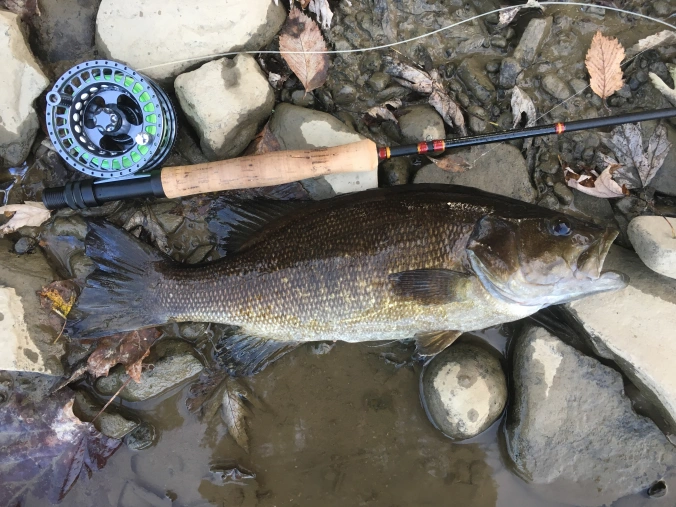
Cast and step, cast and step, I moved down the riffle, systematically working the grids my eyes projected on it.  I was tight to the fly on each retrieve, moving it slowly so that it danced across bottom. Part way down the riffle, my fly stopped and the water erupted with a nice bass. How many times had I watched this dance play out, yet I could never get enough of the replay. I brought the bass to hand after a good fight, and laid it out on the river’s bank, admiring the purest form of bronze. A picture or two and it was back in the river.

IMG_0697

Darkness grew and the thought that I’d need to head back to the access dogged me. After taking two good bass, there was still enough light for a few more casts. The riffle faded into a deep slow pool as I waded down-river and Lady Luck looked down on me once more as I strip-set into a bass that catapulted out of the water and landed with the heaviness of a trophy fish. I fought the bass with my rod tip low, trying to keep it from launching airborne, but it jumped nevertheless – a testament to its strength and wisdom. It always seemed ironic to me that bass would jump out of their watery world – their home – to free themselves in an environment that was hostile to them. For the bigger older fish, maybe it was just their way of showing they still had it in them.

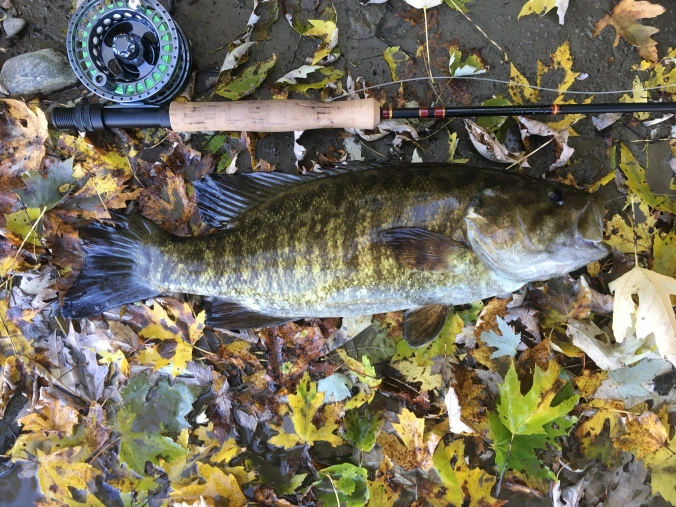
Some give and take followed – I savored the head shakes and short powerful lunges of this bass knowing they very well would be the season’s last. Eventually I beached it, a dandy of a smallmouth with incredible river camo only Mother Nature could create. I cradled the bass – most likely a female, embracing her heft – the fullness of her body – the clear eyes and tiger stripes, a fish in its prime – and I wondered how much longer she would hunt the Susquehanna. This fish was at least ten years old – maybe as old as fifteen – a truly special fish and one that had beaten the survival odds – a fish that had, in the words of Eric Mastroberti, a local fly fisherman, “the genes of an Olympic champion.”

I knelt by the bass at the river’s edge, carefully removed my fly, and waded out again, holding her head-first into the current. She slowly breathed the lifeblood – water as old as time – and came alive in my hands. I held her suspended in the flow and waited until she decided to swim away. And she did, turning with the current and slowly moving into dusk’s river shadows.

IMG_0715

The sun bid its adieu, now dropping below the tree-line and I turned and made my way back to the access, a mile or more of a walk and wade upriver. I reflected on the nearing end of the river feast, the winter to come, and on age. I too was up there in years, but unlike fish, humans live a much longer life that tails out to where we made our entrance. Helpless at birth, wholly dependent, we age to a point where we return again, ever fading, losing strength, the life force ebbing away. But fish just grow until natural causes end things. With old age, a fish keeps gaining strength and size and more certainty of survival against all the threats of a river – apex predators, raptors, and fishermen.

As I made my way up a side channel, the water quickened where it swept past a fallen tree. The river was deep there, its relentless push having scoured out the bottom. I waded further along, tenuously holding branches as I made my way past the obstacle. Once clear, I saw a large snapping turtle river walking down current, head extended, its shell mottled brown and green. ‘Another old warrior,’ I thought – it’s believed that snapping turtles can live as long as a human. And like me, this old guy had no doubt taken his share of smallmouth bass.

I reflected on the fact that despite my age, fishing always seemed to remove me from any awareness of time. Indeed, I felt young whenever I fished. Sometimes a leg would ache where it would have been spry so many years ago, and my balance at times, though not an issue yet, benefited from a wading staff by my side. But still, all my years vanished in the midst of a cast. Immersed in that old river, in the company of its old friends, I felt young.

The memory now deeply ingrained kept playing in my head as I continued on my way upriver; that of a big smallmouth jumping clear of its old world. And as it did, I kicked and strode into the river’s current with renewed vigor, and perhaps too, as a man half my age…

IMG_0699