One angler's journey, fly fishing through life

Month: June 2026

The Last Studs

Mama always said there’s an awful lot you can tell about a person by their shoes. Where they’ going, where they been. I’ve worn lots of shoes. I bet if I think about it real hard, I could remember my first pair of shoes. Mama said they’d take me anywhere. She said they was my magic shoes.

Forrest Gump

I got out of the river that evening, happily tired, and made my way back to my car with an 18″ smallmouth and channel cats that pushed the 30″ mark fresh in memory. The wading had been precarious in the run I had chosen to fish, but it was all well worth it. My boots had taken me there, as they had so many other beautiful and productive places and safely got me out.

I had been wading wet for the last few weeks now that summer was in the fore and I liked the fact that I didn’t have to mess with waders. As I pulled my boots off, I noticed for the first time that I had finally broken through the toe of my left boot. These old Simms boots had taken me fishing for 7 years and were finally about done. I had enjoyed them as much as I did the places they carried me and I didn’t want to say goodbye to a pair of old friends just yet. Then I remembered the cobbler down on Main Street. Perhaps he could work the magic he once did for me on an old pair of Hodgeman’s.

My old Hodgeman wading boots.

I hadn’t visited the cobbler for a long while. One of the great quality conundrums is that exceptional quality can sometimes backfire on a business, particularly a small one. Long lasting shoes, for one, are a thing of the past in today’s throw-away society. My last pair of boots were brought back from extinction thanks to true craftsmanship and those visits to my cobbler saved me the cost or replacement several times over for a very small sum of cash handed, almost with guilt, over the counter.

So one fall evening I drove down to Main Street in Vestal, another Main Street largely bypassed and forgotten and mostly barren now save a nail salon, an antiques dealer, a Chinese food takeout, and what I thought would be my cobbler. But sadly, it wasn’t so. The old shoe-shaped sign was now worn, weathered, and somberly saying “out of business”. The door still listed the hours but taped to it was a sign stating, “thanks for your business, it’s time to move on.”

I left the place disappointed. My boots were truly gonners unless I could find another cobbler. I searched online over the next few days to no avail, leaving me no choice but to purchase new.

I settled on Korkers, which in general I liked, but they didn’t quite feel the same. Oh, they were certainly innovative and I wondered what the cobbler would have said about the technology they offered – the Boa “no lace” system, the quick-change soles, the modern look and use of plastics, and even the rear-entry style of their most advanced offering. There were others too, offering soles of high-tech rubber made by Michelin, no less. And then I stumbled on a new joint offering by Patagonia – their line of boots made by Danner. Danner’s take?

What lasts a lifetime? The best wading boots need to be ultra-comfortable and supportive for long days in heavy water. They should grip subsurface terrain, muddy trails and the occasional cross-stream log. They must drain quickly and avoid holding excess water. And on top of being tough as nails, they need a lifetime measured in decades. When Patagonia approached us to partner on the Foot Tractor and River Salt wading boots, we knew it was the start to something good.

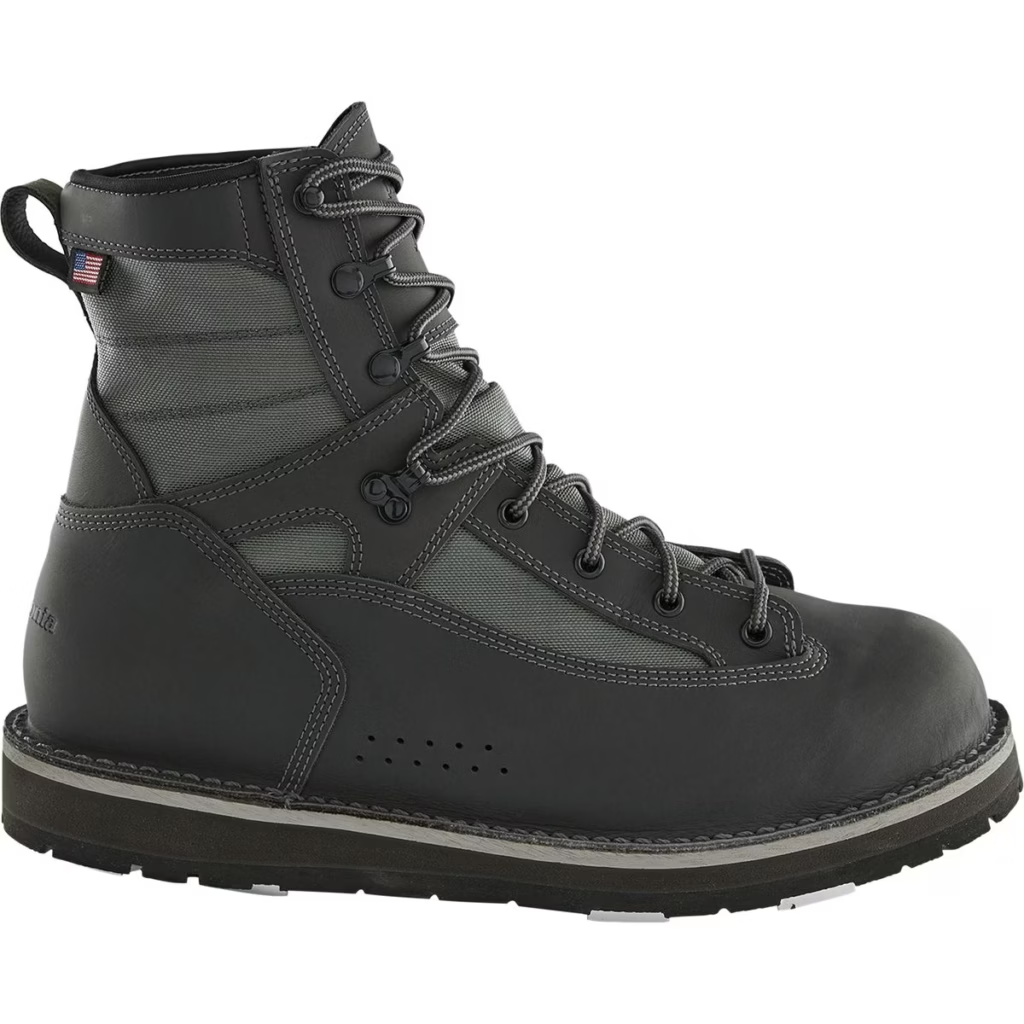
The Patagonia / Danner Foot Tractor

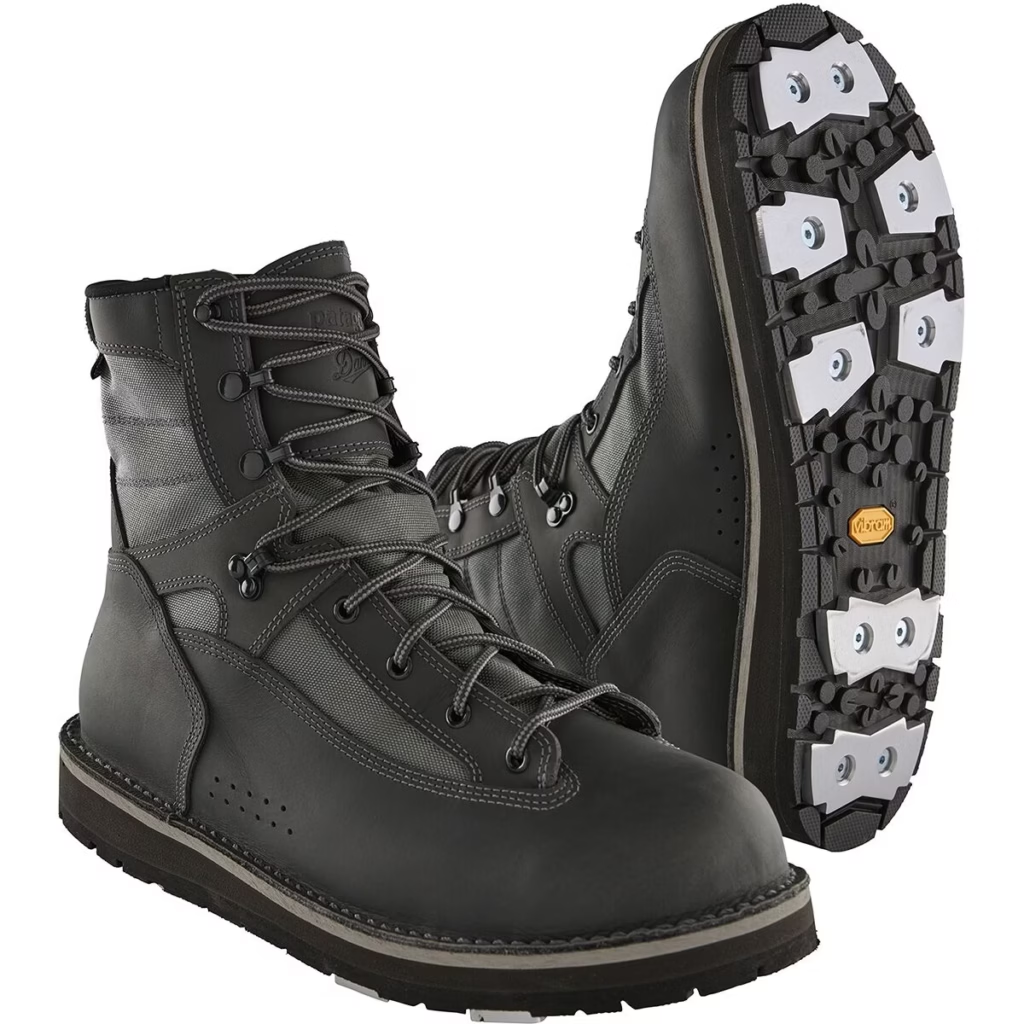
Launched in 2019, this was to be Patagonia’s first-ever brand collaboration with Portland, Oregon-based Danner, producing two wading boots built in the USA: the Foot Tractor designed with a heavy-duty aluminum bar sole for big rocky rivers, and the much lighter River Salt, designed for saltwater flats. Both featured stitch-down construction, full-grain leather, a number of small holes to drain water from inside, a variable lacing system with traditional eyelets on the forefoot and an additional quick lacing system in the ankle area, and best of all, they were resole-able — a rare, sustainability-focused feature in wading boots.
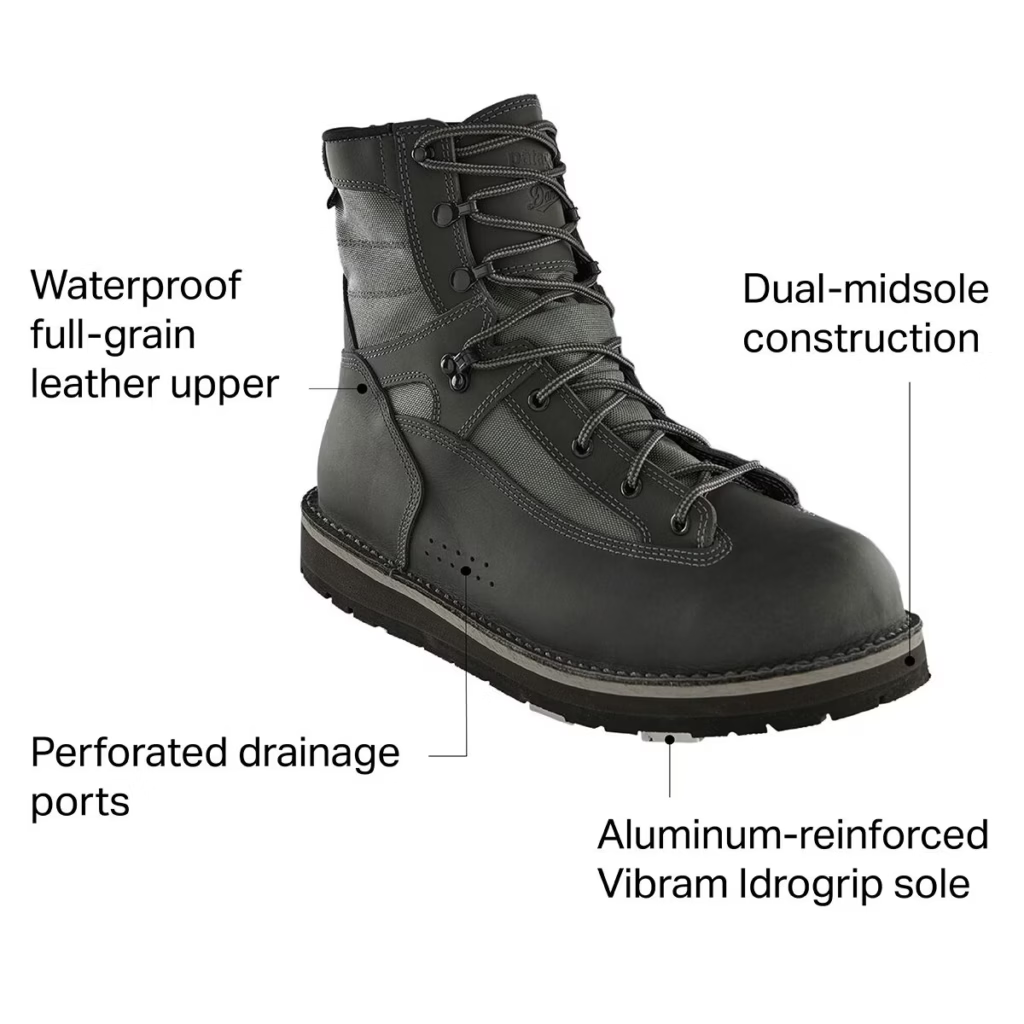
They are widely considered among the best wading boots ever made for durability and repairability. Fly fishing forums note these boots were still holding up after 5–6 seasons of hard use for owners who bought them. They were not cheap, however, fetching a price of $450 to $500.
Apparently, the price was too much for most anglers and Patagonia quietly moved on from the Danner partnership and launched a new collaboration in 2023 — the Forra wading boot, built with Italian bootmaker Fitwell. The Forra is lighter, more hike-oriented, and runs $299, signaling Patagonia shifted focus toward a more versatile, less expensive lighter-weight boot.

So, in my own nonsensical way to honor the cobbler, I researched whether any of these Danner boots were still available. To my surprise and delight, I found some at Backcountry.com. There were a few “foot tractors” in my size discounted 30% from the original price of $499. Most would still cringe at the discounted price, but I thought, what the heck for a boot that could last me the rest of my wading days on this good earth.

And so, with the ease of a click that is our modern-day buying experience, I purchased a pair with a nod to the Main Street cobbler. They’ll arrive soon enough and ooze the aroma of genuine leather and fresh Vibram rubber. I think a baptism in the Salmon River this fall is fitting, hopefully the first of many, many more to come…

Thanks, Dad…

A father is a man who expects his son to be as good a man as he meant to be.
Frank A. Clark

In a touching scene from my favorite movie, Forrest Gump, Forrest learns that his mother is sick and in characteristic fashion, runs home from his work as a shrimp fisherman to be with her. Sitting bedside, his mother tells him that she is dying. When Forrest asks why, she reassures the simple-minded Gump that death is just a part of life, something we are all destined to do. At the end of the scene, she poignantly adds, “I didn’t know it Forrest, but I was destined to be your Mama. I did the best I could…”

And so it is with fathers. Flawed as they often are, fathers show up to work, bring home the bacon, and love in their own quiet way. Fathers are that stern voice that makes children take notice, the very bedrock on which order in the family rests. They are like a feather of destiny, floating on a breeze, just doing the best job possible to land softly on a few great moments in life.

For me, those greatest of moments were when my Dad spent time with me and took me fishing, a sport in which he never participated on his own, but nonetheless made the time for because he loved me. He bought me gifts for fishing, took me on fishing trips, and most of all, gave me life and tucked into it a marvelous little gene that has always drawn me to water…

Fathers of yore often take a bad wrap for old-fashioned values, but I grow more fearful with every Father’s Day that these same values are being lost to us and have been diluted to the point that Father’s Day itself is on its own bad course with destiny.

I look at my own two sons, standing so close to the line that separates man and boy and hope I have given them what my Dad gave me;  that sense that being a father is doing the best you can do with what you have, and hoping they can be as good a man as you meant to be…

Fish Hound

“If I fished only to capture fish, my fishing trips would have ended long ago.

Zane Grey

He sat upright in the back of the pick-up truck, like a tall, dome-headed, and very dignified old man. Adam, owner of FishHound Expeditions, opened the back door of his truck and there he was, “Hatch”, a blue-tick coonhound of massive scale and the namesake for Adam’s growing guiding business. I let Hatch sniff my open hand, then pet him. He lightly pawed at me when I stopped. He had those droopy eyes, lazy ears, and goofy charm only a hound-lover could appreciate. I was smitten…

IMG_7628
“Rado”, left, along with the original FishHound, “Hatch”… (picture courtesy of FishHound Expeditions)

Hatch would not be accommodating my wife and I on our fly fishing float, unfortunately, but there was another “guide dog” in the offing. Adam asked if I was OK fishing with “Little Bear”. After meeting the Malamute/Australian Shepherd mix, I was all aboard.

IMG_2245
Little Bear checks out one of many rainbow trout netted by Jay, our guide.

Before launching our raft, our guide, Jay, told me he needed to take his truck and trailer down to the takeout. My wife followed him in our rental car and Adam drove his truck, already occupied by FishHound Expedition’s two official canines, the honorable Hatch and his sidekick, Rado. Before leaving, Jay set me up with a nymphing rig to fish the beautiful riffle and run at the access while he was gone. One of the many nice offerings FishHound Expeditions provides to customers is tackle and waders. In this case I fished a Redington 9 foot 6 weight rod with WF floating line. The rig was a classic indicator set-up. On the business end Jay had an Alaskan favorite – the bead. I fished the indicator rig at the head of the run and worked it from the top to the tail-out. After just a few casts, I landed a 14″ rainbow that spent more time airborne than in the water. A little later I hooked a 18’ish+ rainbow – another acrobat – but this one threw the hook after a few fantastic sky-borne jumps. Then just in time for the return of Jay, Adam, and my wife to the access, I was into my third rainbow.

20180906_101805
Early success! This third rainbow really made my day and we hadn’t even started the float!

Jay netted my fish and Adam high-five’d me. Shortly after, as we readied the raft for our float, Jay commented that he could see I didn’t need “Fly Fishing 101”, a before-float class he gives to newbie and beginning anglers. It’s always nice to get a compliment from a guide!

Willow Creek is full of wild rainbows. These fish feast on an abundance of salmon eggs in late summer along with the flesh of dead spawned-out salmon. As we began the float, Jay explained that despite the presence of October caddis, midges, and a few mayflies, the rainbows key in on both salmon eggs and salmon flesh as these food sources provide “more bang for the buck” in terms of nutritional value.

IMG_2252
Jay at the oars with Little Bear, ever-present at my side, on lookout…

We launched onto Willow Creek with me in the bow, Jay at the oars, and my wife in the stern seat. My wife was not fishing, but it was a first for me to; 1) have her on a float trip, and 2) have her floating IN waders!

IMG_2243
My wife in waders, and not any low-budget waders, but top-of-the-line Patagonia…

From the access we drifted the clear, cold waters of Willow Creek, a tributary to the Susitna River. We were fishing the lower half of the river. FishHound Expeditions guides the upper and lower Willow, and considers this gem of a tributary to be their home water, and for good reason. The Willow turns out to be one of the most popular fisheries in South Central Alaska, although on the day we fished it, with the salmon run essentially over, it was as if we had the Willow all to ourselves. Located about 60 miles north of Anchorage on the Parks Highway, Willow Creek offers excellent fishing for four of the major salmon species: kings, silvers, chums and pinks. In addition to big rainbows (up to 30 inches), the Willow also holds Dolly Varden, Arctic Grayling, and even small numbers of burbot and whitefish.

Willow Creek gets a strong run of salmon each year because of the excellent spawning habitat it holds. The creek’s bottom is a majority composition of pebbles, cobble, and small rocks. And it is full of snags, the result of downfalls of the white spruce that dominate the land. The creek is named for the presence of of the ubiquitous Alaska willow – not the willow of the Eastern US that Southern Tier fly fishers may be so familiar with – but a shrub-like willow that is the preferred forage for the abundant moose. Indeed, during a bio-break to the bush I saw numerous moose tracks and dung.

Since we were nymphing with an indicator, the key to “bead” success was a true dead-drift presentation. Fishing from a drift boat – in this case a spacious raft – made a dead drift that much easier, but I had no problem hooking up when we stopped and waded a bit as well.

IMG_2255
Willow’s wild rainbows are beautiful, strong, and egg-crazy…

The snags made fishing a little more challenging. The Willow is definitely a “woody” creek and anglers would be advised to have a lot of flies, shot, and rigging materials on hand to do well here. As much as I tried to pull my rig out of potential snags, I still lost flies with some regularity. The saying goes, if you’re not hanging up, you’re not fishing effectively, but I started feeling bad with the number of times Jay had to re-rig me. Nonetheless, Jay always had an alternate rod rigged for the inevitable quick change-out. That alternate rod was rigged the same way but instead of a bead, had a flesh fly on the business end.

As with the bead, I’d never fished a flesh fly. Jay instructed me to fish it dead drift like the bead, but to give it some time to tail out before picking up and casting again. There were dead salmon hung up here and there in the snags, and Jay was able to demonstrate, “in the flesh” (pun intended) what the real thing looks like in the water by nudging a dead salmon. Sure enough, a chunk the size of my fly came loose with Jay’s prod of the oar and it drifted seductively downstream. The flesh fly I was using was tied by Jay, and looked just like the real thing in the water. My first “flesh” drift proved just so as I hooked up with another nice rainbow.

flesh_fly_tan_large
A flesh fly similar to the one Jay tied and had me use.

Partway through our float Jay decided to change things up. At four different times, smaller rainbows rose to the pink indicator I was using. They were beautiful with their plentiful spots, emerging from the clear green of the creek, pausing a millisecond to study the indicator and then trying to take it with a swirl. I laughed at their vigor and Jay added, “can you imagine what they’re thinking?” “That’s gotta be the biggest salmon egg I’ve ever seen…” But that display gave Jay an idea. He tied on a slightly larger bead with a stronger pink color to it. After our shore lunch he showed me a real salmon egg he had found among the pebbles of the creek’s bottom. The bead egg was pretty close to the size and color (very pale white/orange) of the actual egg, but he wanted to see if the size and color change might further improve our results. First cast with the new bead and I was immediately into a rainbow, followed by many more. We continued to use that new color bead along with the flesh fly.

IMG_2269
This rainbow had a faint lime color to its lower sides…

Midway through the float, Jay pulled us over to a long gravel bar. There he set up shore lunch – a small portable grill and cooler – reindeer brats, chips, apples, beer, water. We stood and talked as Jay cooked the brats. Little Bear laid on the gravel, very content. And the Willow washed by.

iPhone Pics 203
Guide-turned-chef, Jay, sets up a nice shore lunch…

After shore lunch, we continued our float down the Willow. The Willow often appeared as creek, stream, and river. Wide sweeping stretches with deep holes made me think more of the West Branch of the Delaware, mid-sized riffles – the Beaverkill, and then narrow choke points had a bit of lower Owego Creek flavor.

As we worked farther downstream, we began to see a few silver salmon in the deeper holes. At one nice run Jay pulled ashore and rigged an 8 weight rod with a streamer. He said it might be possible to rouse one of the silvers if they were holding in the deeper holes and backwaters.

We gave it a shot, casting the Dolly Llama, a favorite streamer for salmon in Alaska…

Dolly_Llama_Tandem_Gold_Cone_Pink_White_large
The Dolly Llama

With no one apparently home in the salmon hole, we continued our float, slipping easily down the Willow.

IMG_E2280
Jay deftly maneuvers our raft through a choke point and downfall…

I’ll never tire of indicator fishing. And on the Willow, it was all the more exciting, casting to its deep snaggy holes and imagining what egg-crazy rainbow might be laying in wait. This was new water, truly wild, and a frontier farther west than I’d ever fished.

We hauled out where the Willow met the Susitna River – a big brawling glacial river, slate-grey in color, braided like a pretzel across a wide river valley. Born of Denali, the Susitna flowed to Anchorage and emptied into the Pacific.

Before hauling out, Jay paused long enough to let me get a few more drifts in. I fished the seam where the Willow’s clear flows met the silty flows of the Susitna, and quickly caught three more rainbows – a wonderful send-off to a trip that went way too fast.

IMG_2284
Last cast…

For those who have never fished Alaska, my experience with FishHound Expeditions had me immediately planning a return trip. I cannot recommend them enough! There are a lot of choices of quality outfitters in Alaska, and on top of that, myriad fishing possibilities from fly fishing small creeks for grayling to fishing the big salmon runs. Locations are another choice with overwhelming possibilities, given the size of the state. But I would definitely consider a trip or trips with FishHound Expeditions, particularly if you are in the Anchorage area. In addition to floats of their homewater, FishHound offers trips to the back country via plane or helicopter. These trips expand opportunities in fly fishing to big fish days and luxury back-country glamping.

As I write this, I am at once missing the good country, great fishing, and the hardy people that make Alaska. This wonderful day on Willow Creek offered a fine taste of a place that beckons me back. One day I’ll return, and maybe, just maybe, spend an extended trip in the backcountry with fishhounds…