One angler's journey, fly fishing through life

Month: August 2026

Fat Nancy’s Philosophy…

““My biggest worry is that my wife, when I’m dead, will sell my fishing gear for what I said I paid for it.”

Koos Brandt

This past weekend son #2 and I took a trip to the great white north.  I’m not talking Albany, Syracuse, or Rochester; I’m talking PULASKI, which, in Polish should translate to “the place where the snow flies” (the village was actually named after General Casimir Pulaski of revolutionary war fame).  Son #2 is a hockey player, and his Bantam Travel “B” Team was to face off against the Salmon River Storm at 11:30 am that day.  We met only mild weather resistance on the trip north, which is a rarity.  In fact, once we passed snowy Syracuse, the skies cleared up but the bright sunshine did little to lift the frigid cold.  Indeed, when we left the Southern Tier the temp was an invigorating -1-degree F.

The village of Pulaski is famous for two things; fishing and snowmobiling.  Situated on the western edge of Lake Ontario, it receives an average of 175 inches (over 14 feet) of snow every winter, but of more interest is the village’s location on the Salmon River.  This geographical blessing makes it one of the best places, arguably THE best place in the lower 48, to catch big steelhead, monster king and coho salmon, and huge lake-run browns.

We arrived in Pulaski, took the exit off Rt 81 North, and at the top of the exit ramp, ran smack dab into Fat Nancy’s on our way to the rink, and with just one look at the interesting name (followed by “tackle shop”), I knew I had to check it out after the game.

We drove through the sleepy village and immediately got a sense for how much snow this part of upstate New York receives.  The roofs of houses and stores were steeped high with the stuff, and the icicles were enough to make one think twice about passing under any roof overhang.  The rink in Pulaski was colder inside than it was outside, but it made for fast ice and a great game, as the Binghamton Senators filleted the Salmon River Storm 12-5.

After the game, we were to head south to Cortland for a 5:30 pm game and lunch en route, but I took a little detour to Fat Nancy’s under the fatherly auspices of picking up a candy bar for my exhausted hockey player and filling the car up with gas in case we ever got stuck in some abominable snow drift.
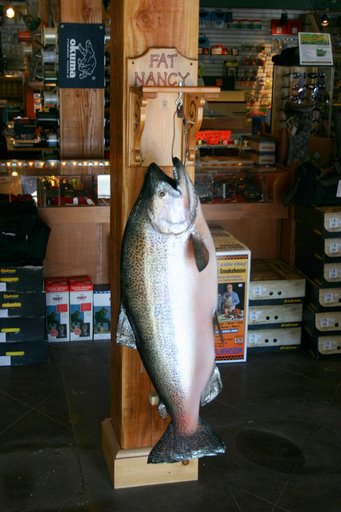
“Many of the women that have worked for us over the years got tired of people coming in the store and asking them if they were Nancy,” Rob said. “The fish is now called Fat Nancy.”

Upon first entering Fat Nancy’s, you’re greeted by one hell of a king salmon (87 lbs. to be exact), although legend has it that “Fat Nancy’ is not the mother of all king salmon, nor is she some gargantuan female tackle shop owner, burly and beard-growing, complete with camel cigarette hanging out of her yap, but instead, a huge sturgeon in Lake Ontario that has eluded anglers for years.  Regardless, this big king, hanging in all its glory for all to dream wistfully of bent fly rods and backing on the reel, is just one of many Salmon River trophies mounted as testament to how truly great the fishing is on the Salmon River. For the record, none other than the Salmon River is home to New York state’s record King salmon – a 47 lb. 13-ounce brute caught in 1991. To catch one the size of Fat Nancy, you’d have to head west to Alaska, home of the US record of 97 lbs. 4 ounces.

There’s also an older piece of Pulaski lore: Fat Nancy Rock, a famous boulder on the Salmon River named after a local woman in the 1800s. It predates the tackle shop by more than a century. The shop’s name is a playful nod to that history.
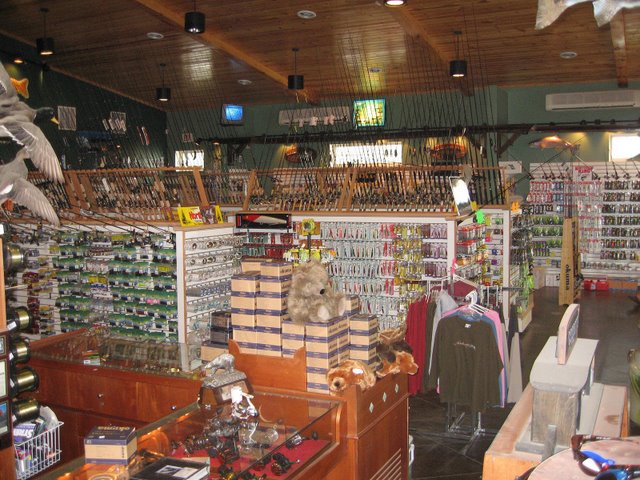
What happens after entry into this fly fisherman’s house of pleasure is sensory overload, as this tackle shop is more like a convenience store version of Cabela’s than a Citgo Mini-Mart. While the shop does cater to the hardware guys, ice fishermen, and trollers, there is a nice stand of G Loomis, Scott, TFO, and some lesser-known brands of fly rods to piqué one’s interest. Fat Nancy’s offers a broad steelhead / salmon fly selection along with a bountiful stock of line, terminal tackle, reels, waders, and clothing. Browsing around, I quickly spied the ultimate big river steelhead rod – a 10′ / 7 weight Scott ARC for sale at half price. I practically had to buy a hat just to catch the slobber that drooled from my mouth.

I picked up a chocolate bar for my very patient hockey player and stood at the counter while a big upstate good-ole-boy sidled up behind the cash register.  “Is that it?”, he bellowed, jowls swaying.  “Yes”, I responded, “although I sure would like to add that Scott ARC you have on sale, but the wife wouldn’t take too kindly to that”.  I chuckled a little, thinking some sympathetic comment would soon follow.  Instead I got a brash and baritone “tough shit”, followed by a lambasting that chastised my manhood and, would have put my tail between my legs if I had one.  “You work for that money, don’t you?”, he scowled, “you can do whatever the hell you want with it, that’s what I say”.  I grimaced and shriveled in the face of this dress-down and soon felt like I was looking up at the counter.  “If you want the rod, buy it, and if she don’t like it, tough shit”. 

I slithered out of the store, my little hockey player in tow, and thought long and hard about “the philosophy” as we sped down Rt 81 to Cortland.  And the more I thought, the more I realized this guy had a point.  The counter-guy’s “pep” talk had truly given me a lift.  Carpe diem, seize the day, strike while the iron’s hot, go for it – the “talk” had convinced me, if nothing else, that Fat Nancy’s was far more than a tackle shop.  Later that week I had a new fly reel on order, with no apologies and nary a second thought, thank you very much.

Fishing with the ladies…

My connection with Destin, Florida is now over 10 years in the making. My wife and I have owned a townhouse there ever since being introduced to the place while visiting our son, Chris, who worked as a PGA Pro at Regatta Bay Golf and Yacht Club. Chris has since moved on to a far different career but our connection to this Florida panhandle city and the beautiful “Emerald Coast” remains.

Destin sits on a long peninsula of land between the Gulf of Mexico and Choctawhatchee Bay – a large saltwater bay, 129 square miles in size, that is fed by the gulf tides to the south and estuary rivers to the north.

destin
An aerial view of Destin. Picture courtesy of flyfishaddiction.blogspot.com.

In addition to an abundance of places to fish saltwater, the area is dotted with ponds and lakes that hold largemouth bass and panfish. Depending on the weather and sea conditions, an angler always has a choice of bay fishing, surf fishing, and pond/lake fishing. There’s rarely a time when a line has to sit dry for long.

OLYMPUS DIGITAL CAMERA
Miles and miles of white sandy beach await the early morning fly fisher…

We are now waning out of August as I write this and memories of the terrific fall fly-fishing here in New York that awaits fills my fly-fishing mind with great anticipation, but maybe because of a spate of hot, humid, weather, I can’t help but think of a late summer visit to Destin years ago and a very special introduction to a “gamefish” of another sort.

August in Destin, oddly enough, is considered “off-season” in terms of tourism. By late July visitors from as far away as Michigan and the upper Midwest, but primarily from the southeast, are leaving. School starts early in the south and the heat and humidity in the panhandle turns downright oppressive. The beaches slowly turn quiet with the ebb of vacationers.

For most of this August visit I chose to fish the surf. I had previously fished Destin in the spring and fall, focusing on the bay. I’d heard summertime had a significant “trash fish” bite, but among that rubble was a gem of a fish that had a reputation as a great adversary on the long rod: the ladyfish…

ladyfish

The ladyfish is a ray-finned fish also referred to as skipjacks, jack-rashes, or tenpounders. They are coastal-dwelling and found throughout the tropical and subtropical regions of the world but occasionally venture into more temperate waters. Ladyfish prey on smaller fish and shrimp. They can grow to over 3 feet in length and may reach 20 pounds in weight. More commonly, they are found to range from 12″ to over 20″. The body of the ladyfish is a tapered spindle shape with an oval cross-section. Their eyes are very large as are their mouths. Their incredible aerial acrobatics in combination with a hard mouth allows them to throw a poorly set hook quite easily. They are largely silver and white in color, but their backs are a light olive to sand color with a beautiful band of light pink where their color transitions to silver.

After arriving at our place and settling in, I rigged my 9 weight fly rod with a full intermediate line and took a quick golf cart ride to the beach. I walked east beyond the swimming area and began casting a size 2 chartreuse and white clouser minnow. It wasn’t long before I was hooked up and witnessing first-hand, the incredible high-jumps of the ladyfish.

ladyfish.jumping.olander.doug
Ladyfish are known as the “poor man’s tarpon” due to their incessant aerobatics, as captured here in this picture courtesy of Doug Olander.

I fished the surf for several days and found varied fishing conditions for these surf-side torpedoes. One day the surf was flat as a mill-pond and I spent much of the day running up and down the beach chasing ladies crashing the beach. Their devastating attacks on glass minnows in the shallows reminded me of bluefish blitzes. On other days the surf was up and the ladies were still biting but were spread out and cruising resulting in a slow but steady bite. One hot afternoon I found them on almost every other cast, though they were not showing themselves as they were on the calmer days.

OLYMPUS DIGITAL CAMERA
I’ll estimate I caught at least a hundred ladyfish over a 4 day period and probably lost another 50 in the process. Ladyfish are built for blitzing bait – a long sleek body, deeply forked tail, big eyes, and a big mouth all make for one terrific gamefish for the saltwater angler.

One group of Mississippi fly fishermen respectfully refer to the ladyfish as the Mississippi tarbone and point out that local anglers can experience much of the thrill of catching tarpon and bonefish without having to leave Mississippi waters.

I found the “ladies” to feed very aggressively and take almost any fly I threw at them. While I didn’t try topwater, I’m sure a large popper thrown into their blitzes would have resulted in regular hook-ups. At times they would feed actively in large schools and could be seen porpoising as they chased bait in the shallows. The most effective flies were shiny, silver, or white. A white clouser with some flash combined with a fast retrieve that imparts plenty of action to the fly is all that is needed to catch these lightening bolts of the salt.

While sometimes difficult to hook, ladyfish will strike again and again on the retrieve. Their mouth is hard and very abrasive; leaders should be checked frequently for fraying. On the advice of the local Orvis fly shop, I used a small bite guard of 30 lb. mono as ladyfish are not at all leader shy. And I’d also recommend not using expensive or intricate flies because they will get chewed up and stripped to a bare hook in no time! A 1/0 stainless hook tied with a lot of flash and some white hackle, or deer hair will do the trick. Don’t spare the glue or epoxy! Simple and bullet-proof will work well.

The fish I caught ranged in size from 12″ to over 24″. Any ladyfish will fight hard but when they get over 18″ you will quickly be grinning ear to ear with their blistering runs and spastic leaps. I caught several larger ones that put a serious bend in my 9 weight and made long reel-screaming runs followed by tarpon-like leaps.

Noreen Galaba ladyfish
A nice-sized ladyfish caught while wading. Photo by Captain Baz Yelverton.

I fished my 9 weight rod because one never knows what will show up in the surf, including redfish, jacks, and sharks, but I could have gone lighter. A 6 – 8 weight rod would work just as well and reduce arm fatigue from casting. A floating line can be used when the fish are in close but I prefer an intermediate or intermediate sink tip to get down in the water column. A simple 30 lb. mono leader transitioning to 20 lb. of 5 to 8 feet in length is all that is needed on the business end. Flies do not need to be big, but I found that a larger hook helps increase hook-ups.

Ladyfish are often cursed by anglers because they can aggressively interfere with fishing for other species. Redfish anglers, for example, will stalk a flat only to hook up with a ladyfish and spook every red on the flat. But I welcome the opportunity to waltz with the “ladies”. I can count on them to join me on the dance floor with every cast. Their high leaps from the emerald waters of the Gulf straight up to the bright blue Florida sky are a delight to behold and I hope to be back to ask for another dance with them come next summer.

Is that a golf ball in your pocket, or are you just happy to be fishing…

“The only reason I played golf was so that I could afford to go hunting and fishing.”

Sam Snead

I tried my best to interest my son in fly fishing, thinking it was something we could enjoy together, an avocation I could pass down the family line. When Chris showed some interest and eagerness early on, I bought him an Orvis 6 weight fly rod and reel outfit, a vest, waders, and took him on a few trips but after only a few ventures out, I could tell he just didn’t have the passion, or perhaps “my passion”. My wife contends I pushed him too hard, which is fair. But all of the die-hard fish heads out there know what I’m talking about: the mojo, moxie, and absolute drive to excel in something so much that time itself stands still. Chris does, thankfully, fish with me at the shore on the party boats out of Barnegat Inlet for blues, fluke, and stripers.  It’s a tradition thing mostly, a father-son “bonding” event, if you will.  But back in my youth, if I had a backyard pond stocked with hungry bass, as once existed just 100 yards out the back door of our home on Grippen Hill, I’d be bankside every chance I got. Chris never wet a line there.

My wife and I stood by Chris in his search for a hobby that would capture his mind and heart, one that would make use of his abundant talents, and possibly turn into a labor of love. There were guitar, lacrosse, paintball, biking, and wrestling, but all of these things were not much more than tossing gas on a baseless fire, producing white-hot flames that burned bright at first but left no enduring embers. 

But then along came golf…

Chris picked up a driver like he did a fly rod, and in no time was clipping balls 225 yards. He has natural talent of which most of us can only dream. He also has the build conducive to the physics of golf – long arms, long torso, and decent height. I remember once casting a new fly rod on the lawn of a local fly shop with him, back when I was trying to cuddle him up to the sport.  The owner bluntly told me that my son, at 13, cast better than I did, 10+ years into the game. As is often said, youth is often wasted on the young.

The hills of Apalachin - from the front 9...
Apalachin Golf Course

So, one April day years ago when he was in high school, we bought him a junior membership at a public course just a few hills over from where we lived at the time and ever since he started that “good walk spoiled”, a funny thing happened – I found golf balls wherever I fished. It began with our pond, which wasn’t too surprising since Chris was constantly practicing on the lawn under our #1 ground rule, “away from the house – toward the pond”. I’d paddle out on the pond and in the shallows, WAY down from where he’d tee off, see these white things on the pond bottom.  Once I was fishing in the stillness of the evening, casting poppers, and nearly jumped out of the kayak when what appeared to be a big bass exploded from the water only feet away. Later, having returned from my back-yard expedition, a smiling Chris asked me how I liked his driving.

He could have been a fly fishing contenda...

But soon after that, more golf balls appeared in remote and very un-golf like places. I found one in the upper Susquehanna River near Windsor where the river is secluded in deep woods and vast tracts of farmland. I found another in the Chemung, downstream from the towering dikes that shoulder the river from the town of Athens. I found still more in the Tioughnioga and the lower Susquehanna, and even, of all places, remote Cayuta Creek.

Going for birdie...

And I would bring them back, every one of them, as proof…

Fresh from the cool mountain springs of Cayuta Creek...

Serendipity?  Chance?  Divine intervention?  Could it be the Big Man’s way of tying the seemingly disparate fires burning deep within us together? I’ve pondered this at length, concluding that, whether chance discovery or breadcrumbs from above, it was indeed a sign that these two great avocations could be shared over the years and vowed I’d someday throw my 8-weight in the back of the golf cart. There had to be some real hawg bass in some of those beautiful water obstacles…

The All-Rounder

You might have heard it as you worked your way up through high school, preparing for college, a profession, or work: “you should go out for track (or band, or the debating club, or…) to be more ‘well-rounded’. Whether that worked out for you or not, there is some merit to the strategy of being a “renaissance man”, so to speak – so much so that a version of the term even eked its way into fly fishing.

The Orvis Company, a giant in fly fishing, began a transition to graphite rods in the early 70’s, thanks to Howard Steere, the superintendent of the Orvis fly rod shop. Steere loved bamboo but had the vision to recognize the potential of graphite as a fly rod blank material. During this era, no company had built a satisfactory graphite fly rod. Orvis eventually came out with their own and these rods included the Orvis 8’3” All Rounder 7wt. The name of the rod recently caught my eye, especially in light of my parent’s well-meaning lectures to be ‘well-rounded’ in life…

41753
The Orvis All-Rounder – 8’3″ of versatility…

While there is truly no all-around fly rod, the Orvis All-Rounder is considered by some to be a good attempt at a noteworthy objective in rod design. It is a full-flex rod with great butt strength and a soft tip and because of its design, it has the ability to cast a lot of line or cast short. The rod handles small flies fairly well yet due to its line rating, can throw streamers in the salt. Its short length allows its use in small streams that have close alder growth and cover.

OldCatalogs018
A description of the All-Rounder found in an old Dan Bailey’s fly fishing catalog…

As I researched the All Rounder, I started to realize how specialized fly fishing product has become. These days one can buy a myriad of fly lines with tapers targeted to specific fish species, casting taper (WF, DT, Intermediate, Sink Tip, etc.,) and even fishing conditions. A recent scan of one online fly fishing store’s inventory showed a Mastery Redfish Warm and Mastery Redfish Cold fly line. Talk about niche fly lines! The same applies to fly rods where the choices must be absolutely bewildering and intimidating for beginners. Material choices have expanded and now include bamboo, fiberglass, and graphite, as well as composite blends. The lengths of fly rods range from diminutive 5-foot creek rods to 14-foot Spey rods, all offering different cork grip options, reel seats, guide types, ferrule types, and sections, including a return to one-piece rods. Actions vary from slow to ultra-fast and then there are rods built for specific species or types of fishing, switch rods and nymph rods being examples of recently marketed niches.

And yet, many of the old timers and the greats of fly fishing did just fine without the specialization. Lee Wulff, for example, spent a lifetime pursuing larger fish on lighter tackle and frequently used a one-piece, six foot bamboo rod to catch fish ranging from small stream trout to Atlantic salmon up to 26 lbs!

wulffpr2

I happen to own a Scott G706/3 (7′ 6 weight 3 piece) that is a replica of the fly rod that Scott’s founder, Harry Wilson, first built for Lee Wulff. It supposedly became Lee’s favorite fly rod, and he used it to catch everything from trout to Atlantic salmon to permit.

8173_lee_wading

None other than Lefty Kreh was once interviewed in an excellent video about his fly-fishing biography during which he bemoaned the fly-fishing industry’s over-pricing of product so that many people – particularly the working class – have not been able to afford to enter the sport of fly fishing. Lefty also discusses fly rods during this video and has an intriguing take on their classification. He breaks down fly rods into 3 categories as follows:

  • Presentation weight – up to 6 weight. These are generally used for trout fishing where tippet protection is of upmost importance.
  • Distance weight – 8 to 10 weight. These are used where distance casting and the use of large / heavy flies is common such as with smallmouth and largemouth bass, pike, and carp and lighter saltwater gamefish.
  • Lifting weight – 12 – 14+ weight. Lifting weight rods are almost exclusively used in saltwater fly fishing where the rod’s primary function is to fight and land big fish.

Lefty’s approach would definitely help any beginner angler slim down their choices to a few, rather than pursuing a stuffed quiver of specialized rods such as I now own, filling up an entire corner of my study. And while Lefty doesn’t see much use for transition weight rods (7 and 11 weight), it’s interesting that the All Rounder happens to fall squarely in the gap between presentation and distance categories.

My own start in fly fishing began with the purchase of a St Croix Pro-Ultra 9-foot 5/6 weight 2-piece fly rod. I bought it at a Dick’s Sporting Goods store for $99. This rod served me well until I began to read fly fishing magazines and then fell under the product trance they sometimes cast. It wasn’t long before I started purchasing higher end specialty rods under the auspices that they would somehow make me a better angler. It’s ironic that even now, with some very good, yet high-priced rods in my stable, I’ll pull out the St Croix.

I’ve often thought of the challenging goal of fly-fishing for a year with some sort of “All Rounder”. I’m certainly no Lee Wulff or Lefty Kreh but maybe fly fishing with one rod could be a good thing for me at one point in my fly-fishing life. It might force me to focus on improving my skills, rather than relying on new fly rod design and technology to bolster me up. And it just might halt my ever-expanding inventory of fly rods, putting a smile on my wife, reducing credit card debt, and even making for a seller’s presence on eBay. We’ve all heard of the one fly challenge – now introducing the one rod challenge, courtesy of the All-Rounder…